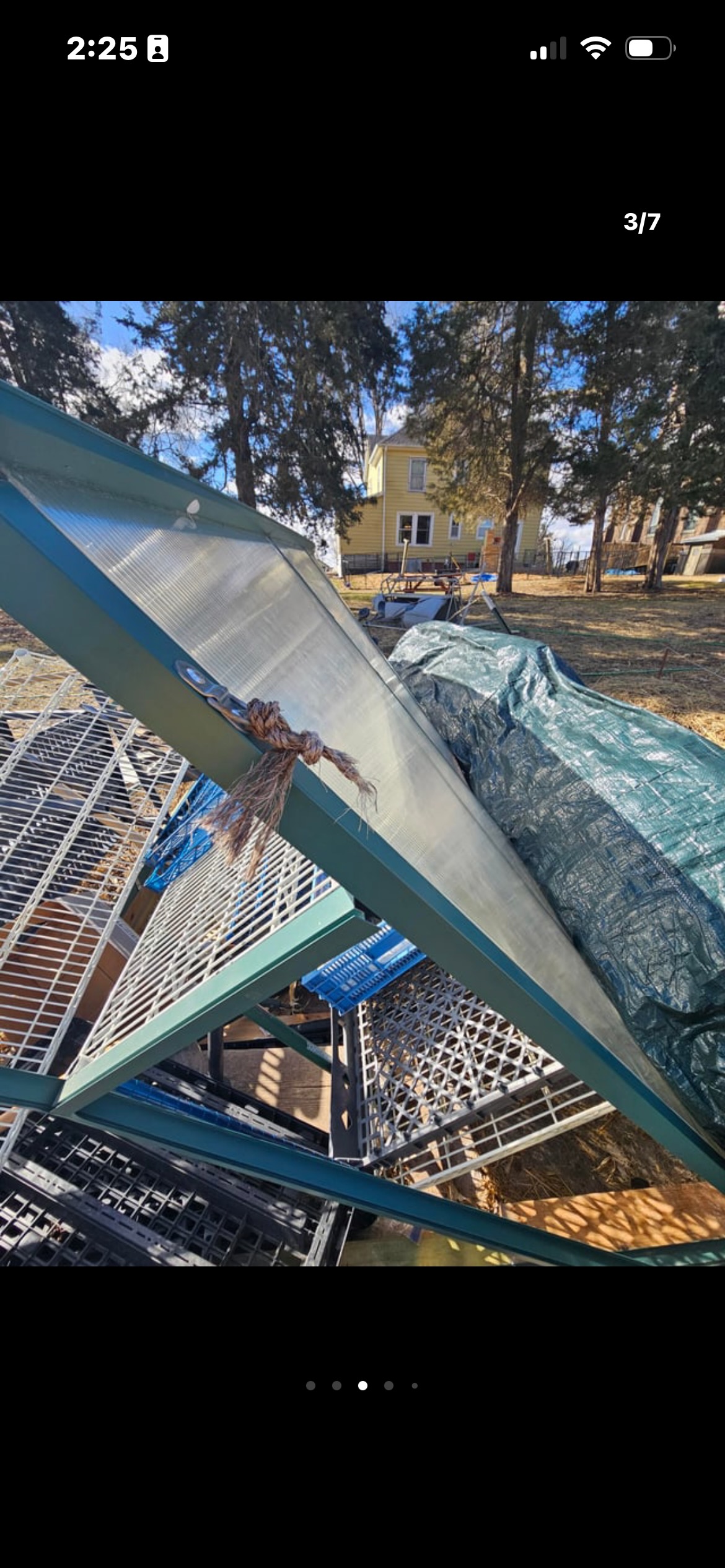
A Reddit thread went around recently. Someone had bought one of those aluminum-frame pop-up greenhouses — the kind with polycarbonate panels and bolted corner brackets. Two hundred dollars. Positive reviews. Looked solid in the photos.
One wind event later, the whole thing was a pile of bent aluminum and shredded plastic scattered across the yard.
The comments filled up fast. Half were commiserating. Half were recommending zip ties, sandbags, ground anchors, rebar stakes. The usual workarounds. The usual attempt to bolt extra fixes onto a structure that failed because of its geometry, not because of missing hardware.
Nobody in the thread talked about the actual problem. The box frame is the problem.
The Sail Effect
A standard rectangular greenhouse is, structurally speaking, a very large sail.
Flat walls present their full surface area to oncoming wind. There is no deflection — the surface has nowhere to redirect force. The wind hits, the force transfers directly into the frame connections, and the frame connections fail. The corner brackets on a pop-up greenhouse are not engineered for that load. They are engineered to hold the panels in position on a calm day.
A curved surface works completely differently. Wind hitting a sphere or cylinder does not transfer cleanly into the structure. It gets redirected along the curve. The pressure differential that would otherwise try to peel the wall apart instead slides around the surface, finding the path of least resistance. The effective wind load on a curved surface is dramatically lower than on an equivalent flat surface facing the same wind.
This is not a small difference. It is why airport radar domes are spherical. It is why water towers are spherical. It is why the Romans built arched aqueducts that are still standing two thousand years later while flat-roofed structures from the same era are rubble.
Where Box Frames Actually Fail
Look at a wind-destroyed pop-up greenhouse and you will almost always see the same failure modes.
Corner bracket shear. The corner is where all three load directions meet — vertical from the roof, horizontal from the wall, and lateral from wind. A bolted aluminum bracket is holding all of that load at once, in shear. When it exceeds the bracket's capacity, it goes suddenly and completely.
Panel peel. The flat polycarbonate panels are under positive pressure on the windward side (wind pushing in) and negative pressure on the leeward side (suction pulling out). Pop-up panel retention is usually a friction fit or a lightweight clip. Either one will fail under real dynamic loading.
Progressive collapse. Once one connection fails, the load redistributes to adjacent connections, which were already at or near capacity. The structure does not bend gracefully. It goes.
This is not a materials problem. It is a geometry problem. You could build the same box frame out of steel and it would still fail faster than a comparably sized curved structure made from wood — because the geometry concentrates load at specific points instead of distributing it across the surface.
How Curved Geometry Handles the Same Load
The Thiosphere is not a perfect sphere — it is a prismatic curved form with flat panels. But the key structural principles still apply.
Load distribution. The triangulated frame spreads forces across multiple members and connections simultaneously. There is no single critical joint. If one connection is under elevated stress, the geometry of the frame redistributes that load to adjacent members. The structure yields incrementally rather than failing catastrophically.
Arched roof sections. The angled roof panels on the Thiosphere create an arch effect. Snow load does not accumulate flat on the surface — it sheds along the slope. Wind does not push up against a flat ceiling — it deflects along the angled surfaces. The roof geometry does work that would otherwise fall to the connections.
Compression, not tension. Arches and curved forms are most efficient when they are in compression. Compression loads are what stone and concrete handle well — which is why stone arches last and brick walls do not fall sideways. The Thiosphere frame puts the structural members in compression under wind and gravity loads. The corner connections in a box frame are in tension and shear. Tension and shear are harder to resist with mechanical connections.
Panel redundancy. Even if a Thiosphere panel were damaged or removed, the frame remains structurally intact. The panels are infill, not structure. The structural work is done by the frame. A box greenhouse, by contrast, relies on the panels for lateral rigidity — which is why removing one panel during assembly (or losing one to wind) can compromise the whole thing.
Why This Matters for Backyard Builders
The pop-up greenhouse market is large and the failure rate is high. Talk to anyone who has owned one and they will tell you: it lasted two seasons, maybe three, before a storm got it or the panel clips started cracking.
That failure rate is not random. It is predictable from the geometry. And the replacement cycle is the business model — sell the same structure every few years when the previous one fails.
We built the Thiosphere with a different assumption: that a backyard structure should last decades, not seasons. That it should be more weather-resistant at the end of year five than a pop-up greenhouse is on day one. That the structure should not need ground anchors and zip ties and sandbags to survive the weather patterns that exist in the place where you live.
That means the geometry has to do real structural work. The shape has to deflect wind, distribute load, and resist collapse through form — not just through heavier hardware bolted onto a fundamentally weak geometry.
The Thiosphere is not the lightest structure in its class. It is not the cheapest to ship. It does not go up in forty-five minutes. Those are real trade-offs and we do not pretend otherwise.
But when the next wind event comes through, it will still be standing.
Explore the Thiosphere Platform — the base module built for real conditions
Design Your Configuration — see how modules connect in your space
Read the Build Documentation — full structural specs and assembly guides