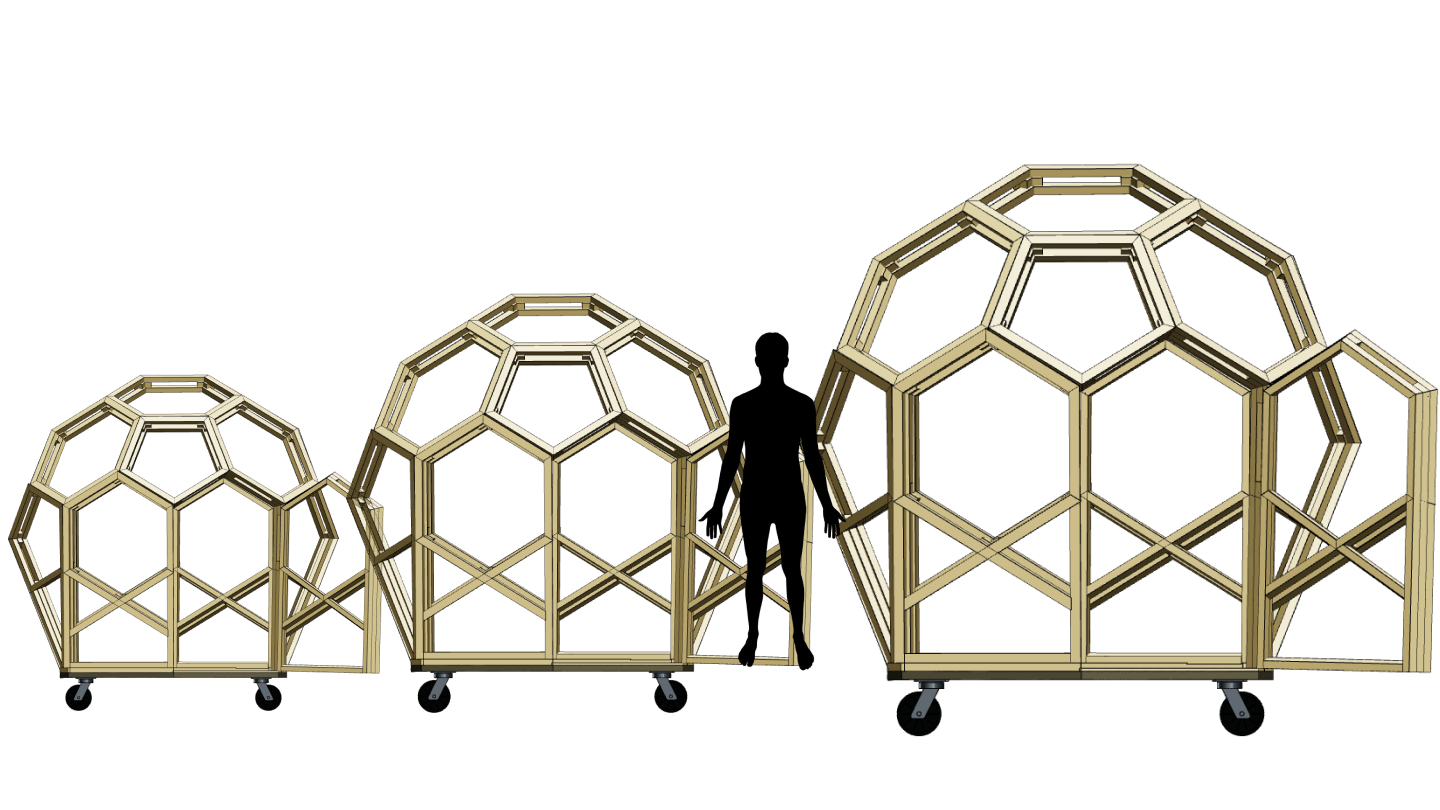
Every Thiosphere you have seen so far is the same size. Same panel dimensions. Same interior volume. Same footprint. That is intentional — standardization is what makes the system buildable with basic tools and standard lumber.
But the geometry is parametric. The relationships between panels, angles, and connections are mathematical, not physical. Change the input dimensions and the entire system scales proportionally. Smaller spheres. Larger spheres. And — this is where it gets interesting — combinations of both.
Why Scale Matters
A standard Thiosphere is sized for human occupancy. Standing height. Room for furniture. Space to move. It is the Goldilocks size for the most common use cases: offices, saunas, studios, guest rooms.
But not every function needs that much space. And some functions need more.
Smaller spheres make sense for:
- Storage and mechanical rooms
- Pet shelters and animal housing
- Planters and small-scale growing
- Utility enclosures (water heaters, electrical panels, batteries)
- Children's play structures
- Display cases and retail kiosks
Larger spheres make sense for:
- Group gathering spaces
- Commercial kitchens
- Workshop areas with large equipment
- Classroom or meeting environments
- Performance and exhibition spaces
The geometry works at any scale. The construction method works at any scale. What changes is the lumber dimensions and the panel count — the system itself is invariant.
The Parametric Advantage
Traditional buildings do not scale well. Double the floor area of a house and you need new engineering: bigger headers, different span calculations, upgraded foundations, revised load paths. The relationship between size and complexity is nonlinear.
Geodesic geometry is different. The structural relationships are ratios, not absolutes. A sphere that is 50% larger uses the same panel angles, the same connection details, the same assembly sequence. The lumber is longer. The panels are bigger. But the build process is identical.
This is what parametric design gives you: one set of plans that generates infinite sizes. The OnShape CAD model that defines the Thiosphere is not a fixed drawing — it is a set of relationships. Change the diameter parameter and every panel, every cut angle, every connection detail updates automatically.
For builders, this means the skills you learn building a standard sphere transfer directly to building a scaled sphere. No new techniques. No new tools. Just different measurements on the same cut list.
Smaller Than Standard
A sphere scaled to roughly 70% of standard dimensions creates an enclosure about the size of a large closet. Not big enough to occupy comfortably, but perfect for functions that need weather protection and structural integrity without human-scale interior space.
The most practical small-sphere application is the utility pod. Solar batteries, inverters, water filtration, tool storage — these all need enclosures that are weatherproof, ventilated, and accessible without being walk-in spaces. A small sphere mounted adjacent to a standard sphere handles all of these needs while maintaining visual and structural consistency across your installation.
Small spheres are also significantly lighter. The panel weight scales with area, which scales with the square of the linear dimension. A 70% scale sphere weighs roughly half what a standard sphere weighs. One person can carry and assemble a small sphere without assistance.
Larger Than Standard
Scaling up by 130-150% creates a sphere with roughly double the interior volume. This is the range where group activities become comfortable — four to six people seated, two to three people working with equipment, or a single person with generous space for large-format work.
Large spheres require heavier lumber. The panels are bigger, the spans are longer, and the structural loads increase. But the construction method remains the same: cut panels, assemble on foundation, connect. You may want a second pair of hands for lifting the larger panels into position, but the joinery and assembly sequence is unchanged.
The foundation requirements scale proportionally. Larger sphere, wider footprint, more foundation points. The point loads are higher but distributed across more contact points, so the ground-bearing pressure stays manageable for standard post-and-pier foundations.
Mixed Scale Combinations
This is where things get really interesting. When you connect spheres of different sizes, you create architectural hierarchy. Big rooms and small rooms. Primary spaces and support spaces. The proportional relationships between connected volumes give the cluster a sense of composition that same-size configurations lack.
Hub and satellite. One large sphere at the center with standard or small spheres radiating outward. The large sphere is the gathering room, the common area, the primary function. The satellites are private rooms, storage, utilities. This reads as a building with a clear spatial hierarchy — not just a collection of identical rooms.
Graduated sequence. Large → standard → small, connected in a line. The experience of moving through this sequence is architectural — the space compresses and expands as you walk through it. This is how cathedrals and temples manipulate spatial experience, and it works at cottage scale too.
Parent and child. A standard sphere with a small sphere attached as an appendage. The small sphere is a bump-out — an alcove, a bay window equivalent, a nook. It extends the floor area of the primary sphere without doubling the structure. Practical applications: a reading nook off a bedroom sphere, a tool closet off a workshop sphere, a seedling starter off a greenhouse sphere.
The Door Panel Connection at Different Scales
Connecting spheres of different sizes requires one accommodation: the door panel on the smaller sphere defines the connection size. The larger sphere receives a door panel sized to match the smaller opening. This means the passageway between a large sphere and a small sphere is sized by the small sphere — logical, since you cannot walk through an opening larger than the smaller room provides.
For connections between standard and large spheres, the passage is standard-door-sized. Comfortable for walking, furniture-moving, and visual connection. For connections involving small spheres (utility pods, storage), the opening is smaller — more of a service hatch than a doorway. This is appropriate for the function: you reach into a utility pod, you do not walk into it.
What We Are Working On
Scaled sphere plans are in active development. The parametric CAD model already generates valid geometry at any scale we have tested. The current work is validating cut lists, optimizing lumber usage at non-standard sizes, and testing connection details between mismatched scales.
We will be sharing mockups of mixed-scale configurations soon — visual studies of how different size combinations create different spatial experiences. The combinatorial possibilities are vast, and we want to show the range before we narrow down to the configurations we will document first.
If you have a specific scaled configuration in mind — a use case that needs a sphere smaller or larger than standard — we want to hear about it. The plans we develop next will be driven by what the community actually wants to build.
Explore the standard size — Get familiar with the base geometry before scaling up or down.
Join the community — Tell us what scaled configurations you would build.
Get the handbook — Current plans cover the standard size with all panel types and connections.