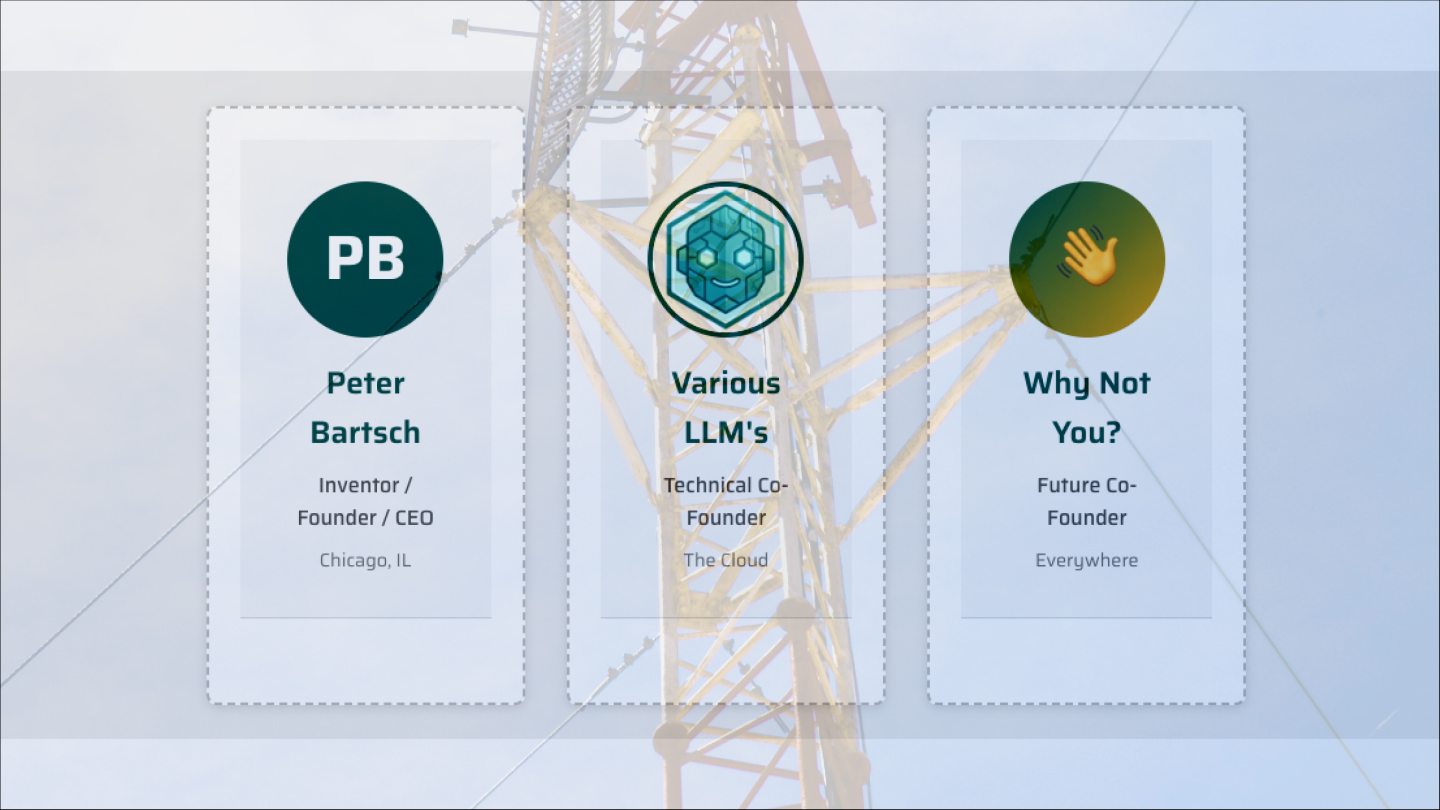
I'm going to tell you something that might make you uncomfortable: I use AI extensively to build Thios. Not just for writing emails or generating marketing copy — for core development work.
I'm writing this post because I believe in transparency. If you're buying a handbook or joining the community, you deserve to know how this company actually operates.
The Solo Founder Problem
Building an open-source hardware company requires an absurd range of skills:
Hardware side:
- CAD design
- Structural engineering
- Materials science
- Prototype fabrication
- Testing and iteration
Software side:
- Web development (frontend + backend)
- E-commerce integration
- Authentication systems
- Database design
- DevOps and hosting
Business side:
- Legal (licensing, terms of service)
- Accounting
- Marketing
- Customer support
- Community management
A traditional startup would hire specialists for each area. A 10-person team, minimum, to cover all these bases competently.
I'm one person with a laptop and a workshop.
Enter the AI Cofounder
In early 2024, I started treating AI as a technical co-founder rather than just a tool. The distinction matters.
A tool is something you use for specific tasks. You open it, do the thing, close it.
A co-founder is someone you work with continuously. You discuss strategy. You iterate together. You divide labor based on strengths.
Here's how I divide labor with AI:
What AI Does Well
Code generation: When I need a Stripe integration, I don't spend hours reading Stripe's documentation and writing boilerplate. I describe what I want, AI generates the code, I review and modify it.
Technical writing: Documentation, README files, API references. AI can produce first drafts that I then edit for accuracy and voice.
Research synthesis: "What are the building codes for accessory dwelling units in California?" AI can summarize complex regulatory information faster than I can read the source documents.
Debugging: When something breaks, AI can analyze error logs and suggest fixes. It's like having a senior developer looking over my shoulder.
Translation: The Thios site supports 16 languages. AI handles the initial translations; native speakers review critical pages.
What I Do
Physical prototyping: AI can't hold a saw. Building and testing actual structures is entirely human work.
Design decisions: AI can generate options, but deciding which direction to take requires human judgment about aesthetics, usability, and values.
Customer conversations: Real support interactions, community discussions, partnership negotiations — these need a human.
Quality control: AI generates, I verify. Every piece of code gets reviewed. Every piece of content gets edited. AI makes mistakes; catching them is my job.
Vision and strategy: Where is this company going? What matters? What should we build next? These questions require human intuition and values.
A Concrete Example: Building the Store
Let me walk you through how AI co-founding actually works in practice.
When I decided Thios needed an e-commerce store, here's what happened:
Day 1: Architecture Discussion
I described what I wanted: a simple store for digital handbooks, integrated with Stripe, with user accounts for managing purchases. AI suggested technology options (Next.js, various payment processors), we discussed tradeoffs, settled on an approach.
Day 2-3: Initial Build
AI generated the core application structure — routing, database schema, authentication flow. I reviewed each piece, modified what didn't match my mental model, asked for changes.
Day 4: Stripe Integration
This was the most AI-assisted part. Payment integrations are fiddly and require exact adherence to API specifications. AI generated the webhook handlers, checkout flow, and error handling. I tested extensively.
Day 5-7: Polish and Edge Cases
What happens if payment fails? What if someone requests a refund? What about users in the EU (GDPR compliance)? We worked through scenarios together, AI generating code, me testing and refining.
Week 2: Launch and Fixes
Real users found bugs I'd missed. AI helped diagnose and fix issues quickly.
Total time: about 2 weeks from concept to functional store.
Without AI, this would have taken me 2-3 months — if I could have done it at all. Stripe integrations are notoriously complex; I'd probably have made security mistakes that would have cost me later.
The Multiplication Effect
People ask me for stats. Here's my honest estimate of how AI affects my productivity:
| Task | Without AI | With AI | Multiplier |
|------|-----------|---------|------------|
| Basic web development | 40 hours | 10 hours | 4x |
| Complex integrations | 80 hours | 20 hours | 4x |
| Documentation | 20 hours | 5 hours | 4x |
| Research | 10 hours | 2 hours | 5x |
| Content first drafts | 8 hours | 2 hours | 4x |
| Debugging | 10 hours | 4 hours | 2.5x |
Overall, I estimate AI makes me 3-5x more productive on technical work.
But the more important effect isn't speed — it's capability. There are things I simply couldn't do before:
- I'm not a professional web developer. Without AI, the Thios website would be a WordPress template with broken mobile layouts.
- I don't know 16 languages. Without AI, the site would be English-only.
- I'm not a lawyer. Without AI, the terms of service would be copy-pasted from somewhere and probably wrong.
AI doesn't just make me faster. It makes me able.
The Concerns (And My Responses)
When I tell people about AI co-founding, I get predictable concerns:
"Isn't the code lower quality?"
Sometimes, yes. AI-generated code can be verbose, use outdated patterns, or miss edge cases.
That's why I review everything. I'm not blindly shipping AI output. I'm using AI to generate first drafts that I then refine.
The resulting code is probably better than what I'd write alone, because AI knows patterns I don't. But it's definitely not as good as what an experienced full-stack developer would write.
For an open-source hardware project with a $29 handbook? The code is good enough. I'd rather ship working software today than perfect software never.
"What about AI mistakes?"
AI makes mistakes constantly. It hallucinates. It misunderstands requirements. It generates code that looks correct but doesn't work.
My job is to catch those mistakes. Every piece of code gets tested. Every piece of content gets fact-checked. I don't trust AI — I verify.
The mistakes that slip through are usually minor. A broken link. A typo that autocorrect created. These get fixed quickly when users report them.
"Doesn't this feel dishonest?"
This is the concern I take most seriously.
When you buy a Thios handbook, are you being misled about what you're getting? I don't think so.
The handbook contains accurate information about building structures. That information came from real prototypes that I physically built and tested. AI helped with documentation, but the underlying knowledge is real.
The website was built with AI assistance, but it works. The store processes payments correctly. The downloads function.
What matters to customers is whether the product works, not how it was made.
Still, I understand the discomfort. That's why I'm writing this post. Full transparency about how Thios operates.
"What happens if AI tools disappear?"
A reasonable concern. What if OpenAI goes out of business? What if pricing becomes prohibitive?
I'd be slower without AI. Much slower. But the core knowledge — how to design and build modular structures — lives in my head and in the documentation. I could continue without AI; I just wouldn't be able to do as much.
Also, AI tools are becoming more available, not less. If one tool disappears, alternatives exist.
What This Means for Thios
If you're considering buying a handbook or joining the community, here's what AI co-founding means for you:
The designs are real. I physically build and test prototypes. AI can't do that. When the handbook says a joint can support X pounds, that's based on actual testing.
The software mostly works. There are bugs. They get fixed. AI helps me fix them faster than I could alone.
Response times are reasonable. I'm one person, but AI helps me handle support requests, write documentation, and manage the community more efficiently than I could alone.
The project is sustainable. A solo founder using AI can operate at lower costs than a traditional startup. Lower costs mean lower prices and longer runway.
The Bigger Picture
I think AI-augmented solo founders are going to become common. Not because everyone wants to work alone, but because the economics are compelling.
A traditional hardware startup raises $2M, hires 10 people, spends 18 months building something that might work.
A solo founder with AI spends $10K, works for 6 months, ships something that definitely works — because they can iterate faster and don't have coordination overhead.
The second approach won't work for everything. Some problems genuinely require large teams. But for focused products with clear scope? The solo + AI model is powerful.
Thios is my experiment in this model. So far, it's working.
Stay Skeptical, Stay Curious
If reading this makes you uncomfortable, that's understandable. AI is changing how things get built, and change is unsettling.
I'd encourage you to evaluate Thios on the merits: Does the product work? Is the pricing fair? Is the community helpful?
If the answer is yes, does it matter that AI helped build it?
I don't think it does. But I respect that you might disagree.
Either way, now you know how this works.
Questions about how AI is used at Thios? Ask in our Discord — I'll answer honestly.
Want to see what we've built? Explore the site or try the configurator.