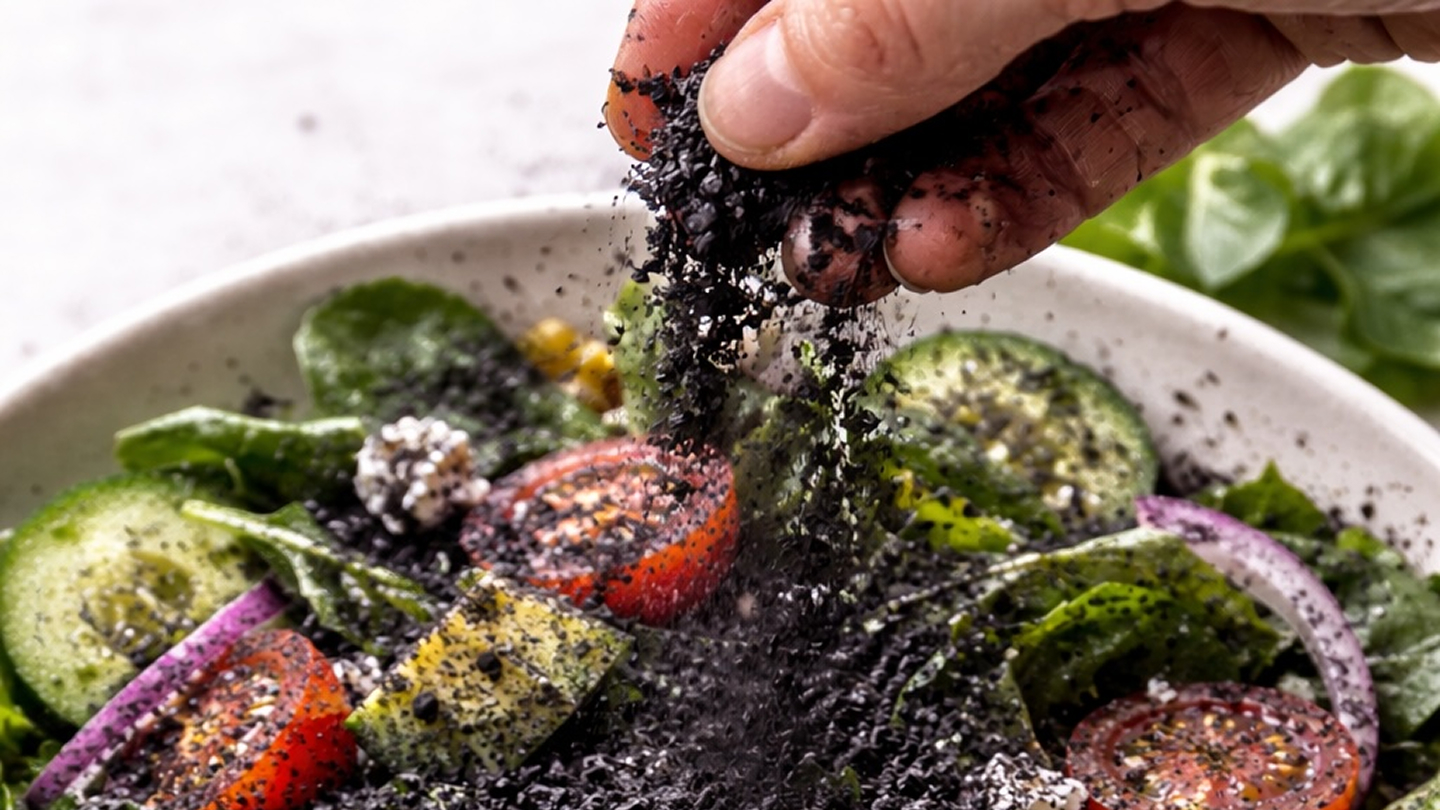
It started because I wanted to get the carbon out of my salad.
I'm sitting at my desk eating a "healthy" lunch — mixed greens, cherry tomatoes, cucumber. And I start thinking about where this food came from.
The lettuce: probably grown in Arizona or California, trucked 1,500 miles in a refrigerated trailer.
The tomatoes: possibly from Mexico, maybe from a greenhouse in Canada heated by natural gas, depending on the season.
The cucumber: could be from anywhere. These things travel.
By the time my "healthy, local" salad reaches my fork, it's accumulated 5-10 pounds of CO2 in transportation, refrigeration, and supply chain overhead. That's before we even count the growing and packaging.
This bothered me more than it probably should have.
The Obvious Solution (That Doesn't Work)
"Grow your own!" is the obvious answer. And I tried. Over several years, I tried:
Kitchen countertop systems: Those little hydroponic gadgets that grow herbs on your counter. Problems: tiny capacity (maybe 6 plants), high electricity use (LED lights on timers), and I was still buying 95% of my greens at the store.
Backyard garden: More productive, but seasonal. In Minnesota, that means 4-5 months of growing, then back to trucked-in produce. Also requires constant attention — watering, weeding, pest management.
CSA membership: Community Supported Agriculture. I got weekly boxes of local produce. Genuinely lower carbon than grocery store greens. But expensive ($30-40/week), still seasonal, and I had no control over what showed up.
None of these actually solved the problem. I wanted year-round greens, genuinely local (like, walking-to-my-backyard local), with minimal carbon footprint.
Why Not Vertical Farming?
When I started researching, vertical farming seemed like the answer. Companies were building giant indoor farms, stacking growing beds floor to ceiling, promising hyper-local produce with no transportation.
Then I looked at the actual numbers.
A typical vertical farm consumes 38 kWh of electricity per kilogram of lettuce produced. That's mostly lighting — LEDs running 16-18 hours a day to replace sunlight.
In most of the US, that electricity comes from natural gas or coal. Even in places with cleaner grids, you're converting fuel to electricity to light to plants. The efficiency losses compound.
One analysis found that vertical farm lettuce has a higher carbon footprint than trucked lettuce — because the transportation emissions are smaller than the energy emissions of artificial lighting.
Vertical farming makes sense in a few scenarios: high-value crops (saffron, specialty herbs), places where land is extremely expensive (Singapore), or where transportation is impossible (Antarctica research stations).
For everyday salad greens? The math doesn't work.
The Question That Changed Everything
I was complaining about this to a friend — an engineer — and he asked a simple question:
"What if you could use actual sunlight but still control the environment?"
I'd been assuming the choice was binary: either outdoors (sunlight but no climate control) or indoors (climate control but artificial light).
But what about a structure that lets sunlight in while maintaining temperature? A greenhouse, basically — but one that could handle Minnesota winters.
The problem with typical greenhouses: they're expensive ($5,000-15,000 for anything substantial), permanently installed, and still require significant heating in cold climates.
What if the greenhouse itself could be cheap enough that the energy savings paid for it? What if it could be modular enough to relocate or expand? What if anyone could build one?
This is where the Agrosphere concept was born.
Designing the Agrosphere
I started sketching. The key insight: a sphere has the minimum surface area for a given volume.
Why does this matter? Surface area is where heat escapes. Less surface area = less heating cost = smaller carbon footprint = eventually net-negative compared to trucked produce.
A 10-foot-diameter sphere has:
- Volume: 523 cubic feet
- Surface area: 314 square feet
- Ratio: 1.67 cubic feet per square foot of surface
A 10-foot cube has:
- Volume: 1000 cubic feet
- Surface area: 600 square feet
- Ratio: 1.67 cubic feet per square foot of surface
Wait, that's the same ratio. Did I mess up the math?
No — but the sphere's advantage appears in absolute terms. To get 523 cubic feet (the sphere's volume), a rectangular structure would need different dimensions. And here's where it gets interesting: the sphere minimizes surface area for a given volume, which means better insulation performance for the space you actually use.
But building a perfect sphere is hard. Bent surfaces, compound curves, specialized materials. What if we approximated it with flat panels? A polyhedron — a geodesic-ish shape made of triangles and pentagons?
This brought me to the Thiosphere concept: a polyhedral approximation of a sphere, built from flat plywood panels. Not a true geodesic dome (those have their own problems — see my post on that), but something that captures the thermal benefits while remaining buildable by regular people.
From Growing Space to Platform
As I designed the Agrosphere (the growing-specific version), I realized something: the structure was the hard part. The growing systems were relatively simple — shelving, irrigation, climate control.
What if the structure could be adapted for different uses?
Same basic design, but configured for:
- Growing (Agrosphere)
- Sauna (Saunosphere)
- Office (Ergosphere)
- Pool/spa enclosure (Immosphere)
The platform — the Thiosphere base design — could serve multiple functions. "Whatever the Function" became the tagline: WTFosphere.
This felt more valuable than a single-purpose greenhouse. Instead of solving one problem (my salad), I could help solve a whole category of problems: the need for affordable, buildable, adaptable small spaces.
Back to the Salad
But let me return to the original question: can the Agrosphere actually get the carbon out of my salad?
Here's the math, roughly:
Transportation carbon for store-bought greens:
- 1,500 miles by refrigerated truck: ~1.5 kg CO2 per kg of greens
- Let's assume I eat 0.5 kg of greens per week, 52 weeks: 26 kg CO2/year
Agrosphere operating carbon:
- Heating: depends on climate, but in a well-insulated structure with passive solar gain, maybe 500-1000 kWh/year in Minnesota
- At average grid carbon intensity: ~200-400 kg CO2/year
Wait, that's higher than trucked greens. Did I fail?
Not quite. The calculation is incomplete.
Agrosphere structural carbon (amortized):
- Materials: ~500 kg CO2 (lumber, plywood, hardware)
- Spread over 20+ year lifespan: 25 kg CO2/year
Total Agrosphere per year: ~225-425 kg CO2
But: The Agrosphere produces far more than 26 kg of greens per year. A 10-foot-diameter growing space, properly used, can produce 50-100 kg of greens annually.
Per-kilogram comparison:
- Store-bought: ~3 kg CO2/kg greens (including waste and retail overhead)
- Agrosphere: ~3-6 kg CO2/kg greens (depending on heating needs)
In cold climates, it's roughly break-even. In mild climates (minimal heating needed), the Agrosphere wins decisively.
The Real Point
Here's what I've learned: the carbon math is close enough that other factors matter more.
Growing your own food:
- Eliminates food waste (pick what you eat)
- Provides maximum freshness (nutrition declines with time)
- Requires no plastic packaging
- Teaches valuable skills
- Creates connection to food
Even if the carbon footprint were slightly worse (which it isn't in most scenarios), these benefits would be worth it.
And the structure itself, once built, can be repurposed. Don't want to grow anymore? Use it as an office, a yoga studio, a meditation space. The carbon cost of the structure is paid once; the benefits continue indefinitely.
The Invitation
The Agrosphere isn't for everyone. It requires building skill (or willingness to learn). It requires space (a parking spot's worth). It requires maintenance (plants don't water themselves).
But if you've ever felt that disconnect between "healthy eating" and the reality of industrial food systems, the Agrosphere offers a different path.
Grow your salad where you eat it. Know exactly what went into it. Eliminate the supply chain.
It started as a personal frustration with carbon. It became a platform for rethinking how we create and use space.
The salad, by the way, tastes better when it was living an hour ago.
Explore the Agrosphere — our growing-space design.
Get the handbook — complete plans for building your own.
Join the community — share your growing projects and learn from others.