Vertical farming was supposed to revolutionize food. The pitch was compelling: grow food in stacked layers inside warehouses, right next to where people live. No transportation. No weather risk. No pesticides. Year-round production.
Investors poured billions into the industry. AppHarvest raised $500M. Plenty raised over $900M. AeroFarms, Bowery, Gotham Greens, BrightFarms — the money kept flowing.
Then the failures started.
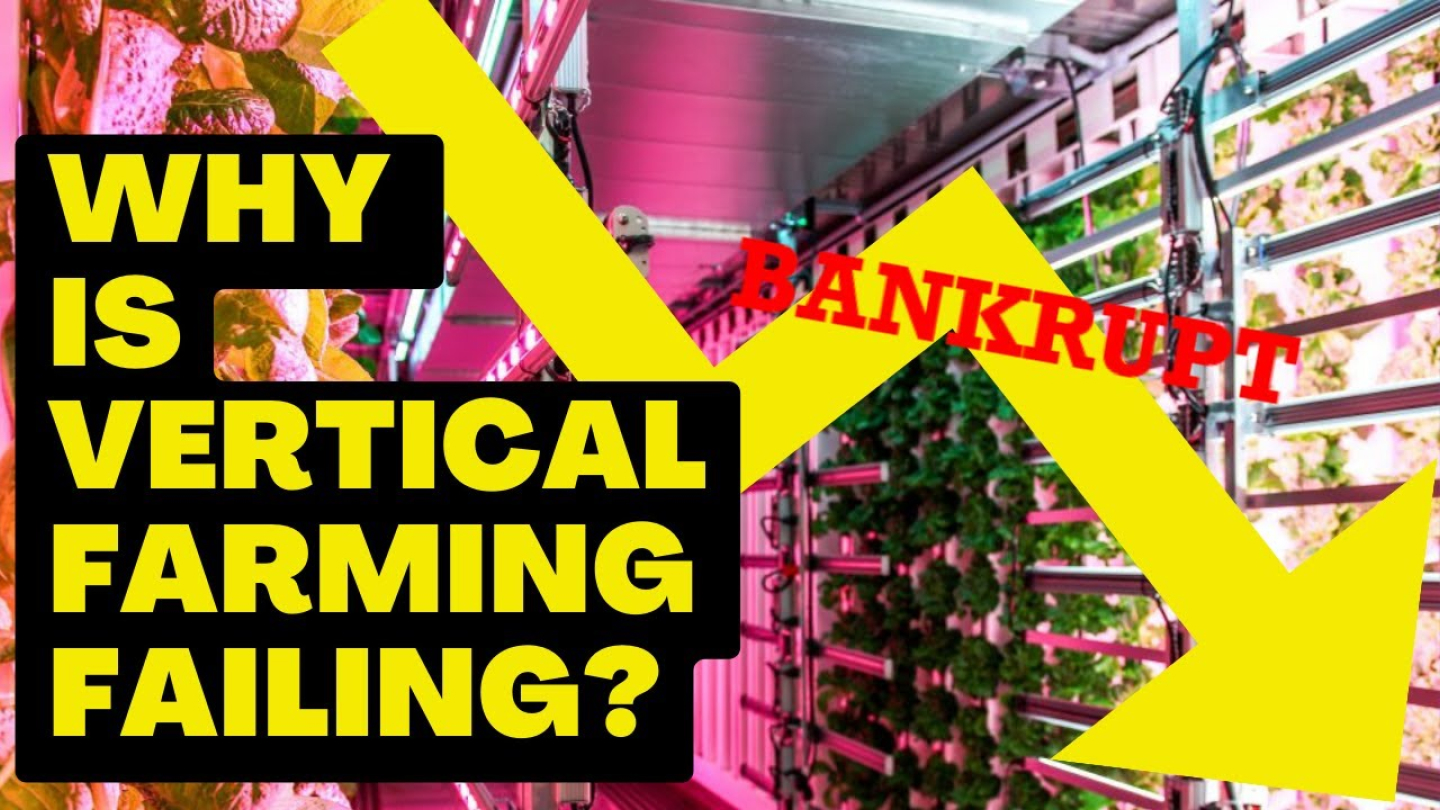
AppHarvest's stock dropped 97% from its peak. AeroFarms filed for bankruptcy in 2023. Multiple vertical farms have closed or scaled back dramatically.
What went wrong? And is there a better approach to local food production?
The Energy Problem
The core problem with vertical farming is physics. Plants need light. When you grow plants indoors, you need to provide that light artificially.
Sunlight delivers about 1,000 watts per square meter at peak intensity. A vertical farm with 10 stacked growing levels needs to deliver 10,000 watts per square meter of floor space — constantly, for 16-18 hours a day.
Modern LEDs are efficient, but they're still only about 50% efficient at converting electricity to photosynthetically useful light. And generating that electricity (unless you're in a nearly 100% renewable grid) produces carbon emissions.
The numbers are stark:
- Traditional field lettuce: 0.3-0.5 kg CO2 per kg lettuce
- Greenhouse lettuce: 0.7-2.0 kg CO2 per kg lettuce
- Vertical farm lettuce: 2.5-6.0 kg CO2 per kg lettuce
The whole point was to reduce environmental impact. Instead, vertical farming often increases it.
The Economics Problem
Even if we set aside environmental concerns, the economics are brutal.
Capital costs: A commercial vertical farm costs $1,000-2,000 per square foot of growing space to build. A 50,000 square foot facility: $50-100 million before growing a single leaf.
Operating costs: Energy is 25-30% of operating costs. Labor is another 25-30%. In an industry where the product (lettuce) sells for $2-4 per head, margins are razor-thin.
Unit economics: Industry estimates suggest vertical farm lettuce costs $0.15-0.30 per ounce to produce. Conventional lettuce is $0.03-0.05 per ounce. The premium market is limited.
To make vertical farming work financially, you need:
- Very high-value crops (not lettuce)
- Very high-cost real estate (where outdoor growing is impossible)
- Or massive scale efficiencies that haven't materialized
The Crop Limitation Problem
There's a reason every vertical farm grows leafy greens: they're the only crop that works.
Plants with fruits (tomatoes, peppers, strawberries) need more light over longer periods. The energy costs multiply.
Root vegetables don't make sense — you can't stack what grows underground.
Grains and staple crops have such thin margins that indoor production is economically impossible.
So vertical farming can produce lettuce, herbs, and some specialty greens. That's maybe 5% of the agricultural market. It's not a food system revolution; it's a niche premium product.
What Actually Solves the Problem?
If the goal is local food with lower environmental impact, what works better than vertical farming?
Option 1: Improved Traditional Greenhouses
Modern greenhouses use supplemental heating (often from renewable sources), passive solar design, and efficient ventilation. They work with sunlight rather than replacing it.
A well-designed greenhouse can produce year-round in most climates, with energy use 80-90% lower than a vertical farm.
The limitation: greenhouses require land area. In expensive urban cores, that land is unavailable or prohibitively costly.
Option 2: Urban Rooftop and Vacant Lot Farming
Cities have more unused space than people realize: rooftops, parking lots, abandoned properties.
Organizations like Brooklyn Grange operate rooftop farms producing hundreds of thousands of pounds of produce annually. The infrastructure cost is a fraction of vertical farming.
The limitation: rooftops have load constraints. Not every building can support growing operations.
Option 3: Distributed Micro-Farming
Here's where I think the real opportunity lies.
Instead of one $50M vertical farm serving a city, imagine 5,000 small growing structures distributed throughout the area.
Each structure:
- Costs $2,000-5,000 to build
- Fits in a parking space (about 180 square feet)
- Produces 50-200 pounds of greens annually
- Uses natural light with minimal supplemental heating
- Is owned and operated by the person who eats the food
Total production: comparable to a commercial vertical farm. Total investment: $10-25 million, distributed among thousands of owners. Total resilience: if one fails, the others continue.
This is the Agrosphere vision.
The Agrosphere Model
The Agrosphere is a small, thermally-efficient growing structure designed for backyard deployment. Here's how the economics compare:
Capital cost: ~$2,300 in materials (less than a nice bicycle)
Operating cost: Minimal electricity for ventilation, water for irrigation. Heating from passive solar plus supplemental when needed. Maybe $100-200/year.
Production: 50-100 kg of greens annually (depending on climate and attention)
Payback: If you buy $400 worth of greens per year (reasonable for someone who eats salad regularly), the structure pays for itself in 6-8 years. Plus you keep it producing indefinitely.
Compare to a vertical farm investment:
- $50M capital, $5M annual operating, maybe 500,000 kg annual production
- Cost per kg: roughly $10-11 year one, improving over time but never below $2-3
The Agrosphere produces at roughly $2-4 per kg once the structure is paid off. It wins on economics and energy.
Resilience Through Distribution
There's a deeper argument for distributed micro-farming: resilience.
Centralized systems have single points of failure. When AeroFarms went bankrupt, their growing capacity vanished. When a vertical farm has equipment problems, production stops.
Distributed systems fail gracefully. If one Agrosphere has problems, 999 others keep producing. There's no CEO to make bad decisions, no investors to satisfy, no bankruptcy court to navigate.
This is the same principle that makes the internet robust (many connected nodes) and centralized systems fragile (one failure cascades).
Food systems should be resilient. Distribution inherently provides resilience.
The Social Benefits
Beyond economics and resilience, distributed growing has social benefits that centralized farming can't match:
Skill development: People learn to grow food. This knowledge transfers — to community gardens, to helping neighbors, to the next generation.
Community building: Agrosphere owners in an area can share knowledge, trade surpluses, help each other troubleshoot. A commercial farm has employees; a distributed network has community.
Independence: You're not reliant on supply chains. Your food doesn't depend on truck drivers, warehouse workers, or retail availability. In a disruption, you still eat.
Health: Home-grown food is fresher. Fresher food has higher nutrient content. Plus the act of gardening itself has documented health benefits.
Vertical farms provide none of this. They're just a different supplier.
What Vertical Farming Got Right
I don't want to be entirely negative. The vertical farming movement got some things right:
Awareness: Millions of people now think about where their food comes from and the environmental impact of food systems. That awareness is valuable regardless of what solutions emerge.
Technology development: LED efficiency has improved dramatically, partly driven by vertical farm demand. Hydroponic and aeroponic systems have matured. These technologies benefit all growing approaches.
Proof of concept: Vertical farms demonstrated that controlled environment agriculture can produce high-quality food year-round. That's not nothing, even if the economics don't work at scale.
The vertical farming industry may have failed economically, but it contributed to a broader movement toward local, sustainable food production.
The Path Forward
Here's my prediction for the next decade of local food:
- Vertical farming consolidates: A few well-funded players survive in niche markets (herbs, microgreens, specialty crops for high-end restaurants). Most current players fail or pivot.
- Traditional greenhouses expand: As energy costs and carbon consciousness rise, efficient greenhouse production becomes more attractive. Expect more greenhouse capacity in suburban areas.
- Distributed growing grows: As housing costs push people to use space more efficiently, backyard growing structures become more common. The Agrosphere and similar designs find their market.
- Hybrid approaches emerge: Some combination of community greenhouses, shared growing spaces, and individual structures. Not fully centralized, not fully distributed.
The food system of the future won't look like one giant vertical farm per city. It'll look like thousands of small growing spaces, connected by shared knowledge and trading relationships.
That's a better future than what the vertical farm industry was selling.
Building the Alternative
If you're interested in local food production, here's my suggestion: start small, start distributed.
Don't wait for some company to build the perfect vertical farm. Build your own growing space. Even a modest structure produces meaningful food while teaching skills you'll use forever.
The Agrosphere handbook includes everything you need: structural plans, growing system design, climate management, and crop recommendations by region. It's $29 — less than two weeks of buying grocery store salad.
The revolution in food production won't come from billion-dollar investments. It'll come from thousands of people deciding to grow their own food, one backyard at a time.
Farm a parking space, not a building.
Explore the Agrosphere — our approach to distributed micro-farming.
Get the handbook — complete plans for building your own growing space.
Join the community — connect with growers sharing their experience.