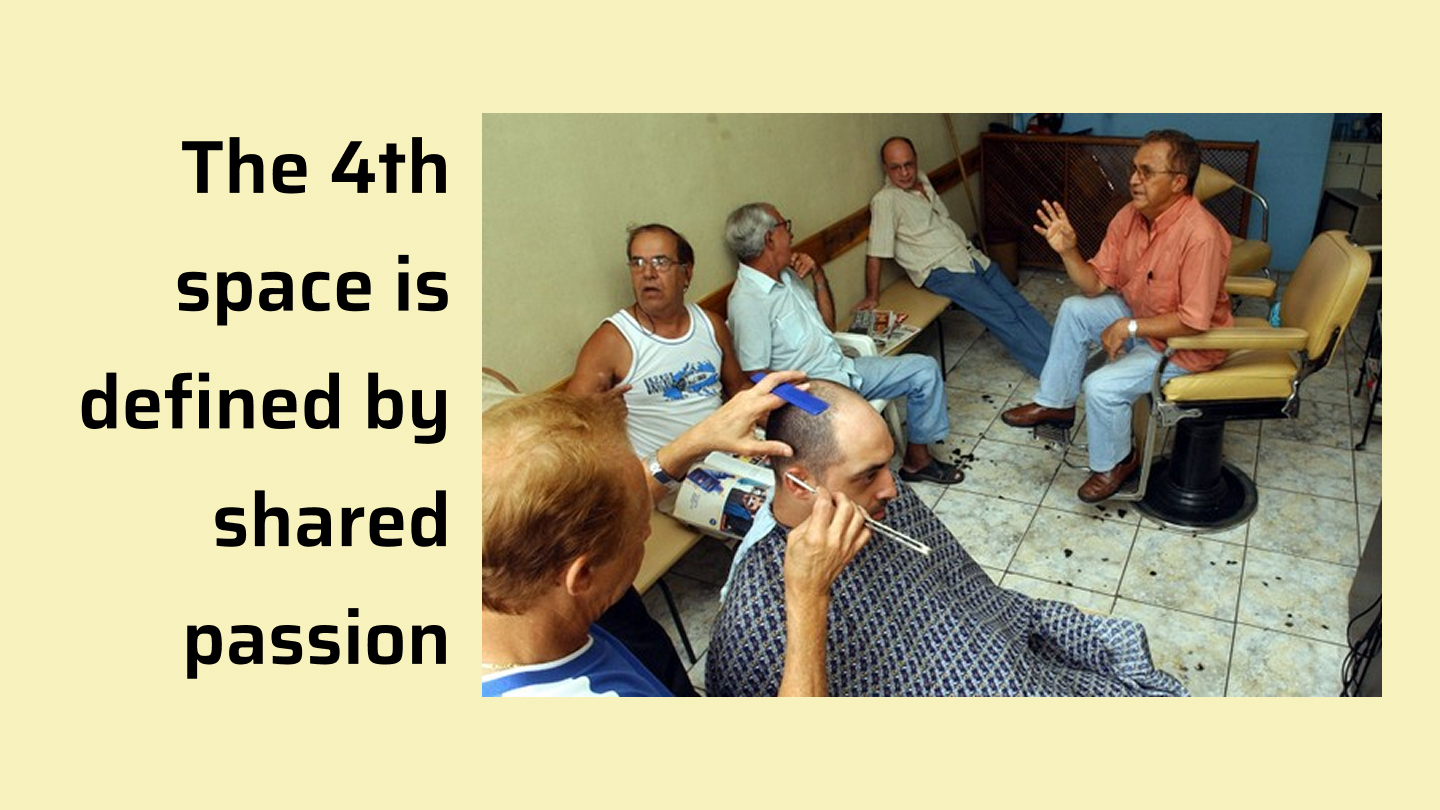
We have home (1st), work (2nd), and cafes (3rd).
Ray Oldenburg named the "third place" in 1989 — the coffee shops, barbershops, and pubs where community life happens outside of home and work. His book The Great Good Place argued that third places are essential for civic engagement and social health.
He was right. And his framework caught on. Starbucks explicitly positioned itself as a "third place." Coworking spaces marketed themselves similarly. Urban planners began designing for third-place gathering.
But Oldenburg's framework is incomplete. He identified three spaces. There's a fourth.
The Missing Quadrant
Let me map the spaces:
| Space | Social Level | Function |
|-------|-------------|----------|
| 1st: Home | Intimate (family) | Living, resting |
| 2nd: Work | Professional (colleagues) | Producing, earning |
| 3rd: Third Place | Community (acquaintances) | Connecting, belonging |
| 4th: ??? | Solitary (self) | Creating, reflecting |
The first three spaces all involve other people — family at home, colleagues at work, community at third places.
The fourth space is yours alone. A place for solitary thought, creative work, personal rituals, and contemplation.
This space used to exist. Workshops behind the house. Studies with locking doors. Retreats in nature. Places where you could be alone with your thoughts, without interruption, without obligation to others.
We've forgotten it.
Why the Fourth Space Disappeared
Several forces combined to eliminate personal sanctuaries:
Housing Economics
In 1970, the median home size in America was 1,500 square feet for a family of 3.5 people. By 2020, median home size reached 2,300 square feet, but families got smaller.
More space per person — except that space is shared. Open floor plans eliminated private rooms. Bedrooms became sleeping-only spaces. The dedicated home office, study, or workshop became luxury features available only to the wealthy.
The average person has more square footage than ever, but less private space.
Connectivity
Smartphones brought the world into our pockets. Email follows us everywhere. Social media creates ambient awareness of others' lives, even when alone.
Solitude became harder to achieve. A room is no longer isolated if it has WiFi. Your "alone time" is interrupted by notifications, messages, and the compulsion to check feeds.
True solitude requires intentional disconnection — which requires a space where disconnection is the default.
Work-Life Blur
Remote work accelerated a trend that was already underway: the collapse of boundaries between work and life.
When you work from home, where is the sanctuary? The kitchen table is an office. The bedroom is adjacent to the workspace. There's no clear separation between productive time and personal time.
Third places tried to fill the gap, but they're social by nature. Working from a coffee shop means ambient conversation, visual stimulation, interruption.
The fourth space — solitary, private, separate — got squeezed out.
Cultural Shifts
Western culture increasingly valorizes connection and collaboration. Networking, teamwork, social media engagement — these are praised. Solitude is viewed with suspicion. "Loner" is pejorative.
But research consistently shows that solitude is essential for:
- Creativity (most creative breakthroughs happen alone)
- Self-reflection (understanding requires quiet)
- Emotional regulation (processing requires space)
- Deep work (focused thinking requires isolation)
The culture tells us to connect. Our brains need time to disconnect.
What the Fourth Space Does
Let me describe what happens in a fourth space:
Creative Work
Creativity requires two phases: exploration (gathering ideas, making connections) and crystallization (focusing, producing, finishing). The first phase is often social — bouncing ideas off others, absorbing influences. The second phase is almost always solitary.
Writers need a room of their own. Painters need studios. Programmers need focus time without interruptions. Musicians need practice spaces. Makers need workshops.
The fourth space is where creative work gets finished.
Reflection
Who are you? What do you want? What matters?
These questions can't be answered in conversation. They require solitary contemplation — time when external stimuli aren't competing for attention, when social expectations aren't shaping responses.
The fourth space is where you meet yourself.
Practice
Skill development requires repetition. Language learning, musical instruments, physical training, meditation — all require regular practice, most of which is solitary and unglamorous.
The fourth space is where practice happens: the daily violin exercises, the morning journaling, the evening yoga, the weekend woodworking.
Ritual
Humans need rituals — repeated activities that mark transitions and create meaning. Morning routines, evening wind-downs, weekly sabbaths, seasonal celebrations.
Many rituals are communal. But some of the most important are personal: the morning coffee meditation, the evening review, the weekend long run.
The fourth space is where personal rituals unfold.
The Thiosphere as Fourth Space
When I designed the Thiosphere, I wasn't thinking explicitly about fourth spaces. I was thinking about backyard saunas, home offices, and workshops.
But I kept hearing the same thing from people interested in the project: "I need somewhere that's mine."
Not family space. Not work space. Not social space. Personal space.
A Thiosphere is exactly that:
Physically separate: In the backyard, the driveway, or the corner of the property. Close enough to access easily, far enough to feel distinct from the house.
Single-purpose: Configured for one use — sauna, office, studio, workshop. When you enter, you know what you're there to do. No multi-use confusion.
Personally controlled: Your space, your rules. No negotiating with family over temperature, decor, or schedule. No workplace policies. No cafe hours.
Connection-resistant: No room for a crowd. The small footprint naturally limits social use. The separate structure discourages casual interruption.
This wasn't the marketing pitch. But it might be the deepest value.
Designing Your Fourth Space
You don't need a Thiosphere to have a fourth space. You need intention.
Claim Territory
Identify space that can be yours alone. A corner of the garage. A basement room. A garden shed. A regular reservation at a private coworking pod.
The key is consistency and exclusivity. This space is always available for you, and it's used only for your solitary purposes.
Remove Connectivity
Disable WiFi. Leave your phone in another room. Create friction between you and the connected world.
This is harder than it sounds. The compulsion to check, to refresh, to respond — it's deeply wired. Your fourth space needs to make disconnection the path of least resistance.
Establish Rituals
Enter the space the same way each time. A transition ritual — changing clothes, making tea, lighting a candle — signals to your brain that something different is beginning.
Exit the space with a closing ritual. Clean up. Review what you did. Set intention for next time.
Rituals transform physical space into psychological space.
Protect Time
A fourth space without time is just storage. You need regular, protected time to use it.
Block your calendar. Tell family you're unavailable. Treat this time as seriously as you'd treat a work meeting or medical appointment.
The fourth space is only as valuable as the time you spend in it.
The Invitation
Ray Oldenburg gave us a framework: home, work, third place. The framework was useful. It shaped how we think about urban design, commercial space, and community building.
But it's incomplete. The fourth space — personal sanctuary — is missing from the framework and increasingly missing from our lives.
The Thiosphere is one way to build a fourth space. Backyard sauna for heat therapy and contemplation. Workshop for making. Office for deep work. Studio for creative practice.
Small enough to fit in a parking space. Big enough to matter.
But the important thing isn't the structure. It's recognizing what's been forgotten.
We need space that's ours alone. Space to create, reflect, and grow. Space where we're not family members, employees, or community participants — just ourselves.
A fourth space. Not lost — forgotten.
It's time to remember.
Explore Thiosphere options — structures for personal sanctuary.
Get the handbook — build your own fourth space.
Join the community — ironically, connect with others who value disconnection.