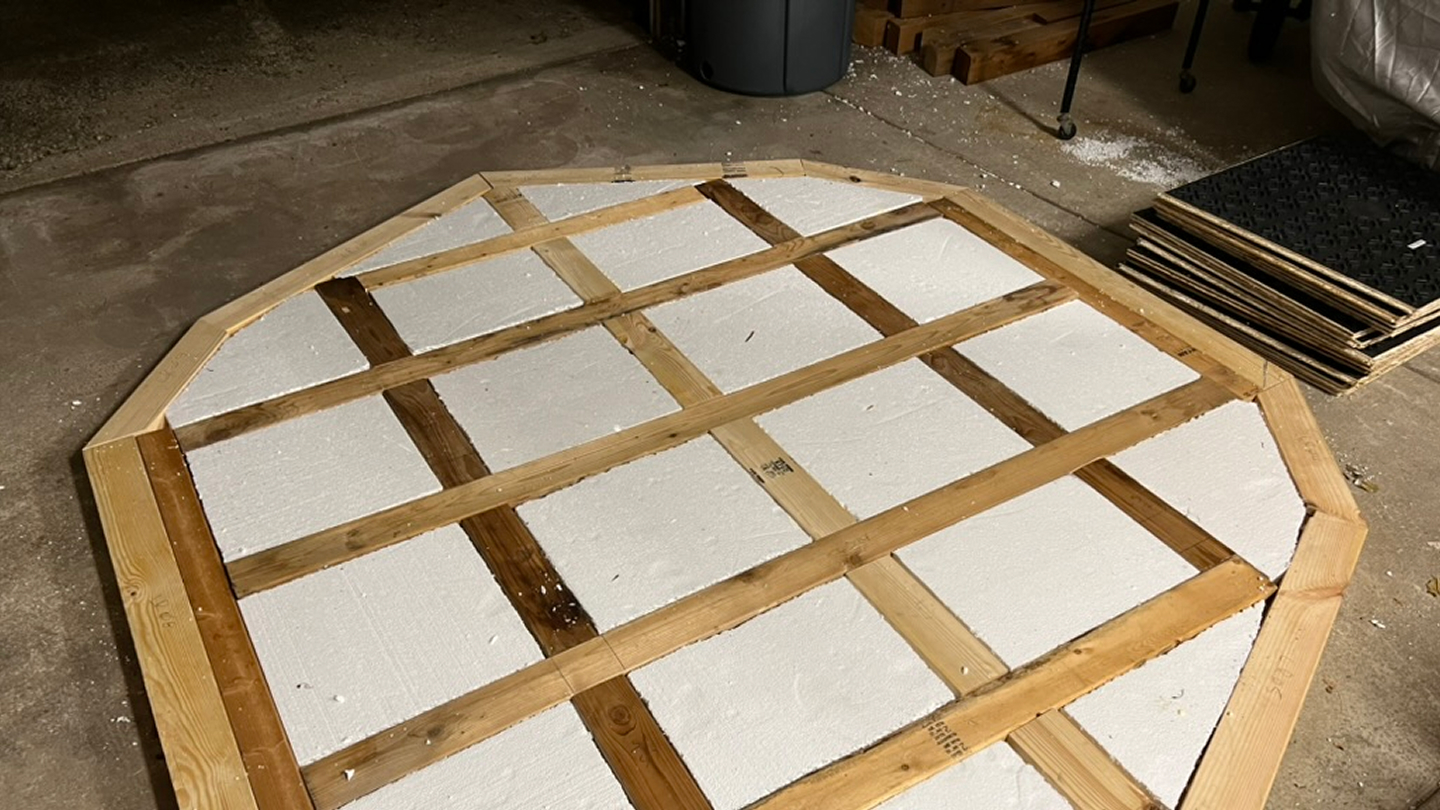
I learned design by taking things apart.
Not from design school (didn't go). Not from engineering textbooks (read some, forgot most). Not from YouTube tutorials (helpful, but superficial).
From teardowns: methodically disassembling products to understand how they work, why they're built the way they are, and what makes some designs better than others.
Before I built the first Thiosphere, I took apart a barrel sauna, three greenhouses, two pop-up canopies, an IKEA wardrobe, a camping tent, and various other structures. Each one taught something that ended up in the final design.
Why Teardown Works
Teardown is reverse engineering with an educational purpose. You're not trying to copy a product — you're trying to understand the designer's decisions.
Every product embodies thousands of decisions: material choices, joining methods, tolerances, assembly sequence, cost tradeoffs. Most of these decisions are invisible in the finished product. Teardown makes them visible.
When you take something apart, you discover:
- What's structural vs. cosmetic: Which parts actually bear load, which are just covers
- Where complexity hides: The mechanisms, the fasteners, the adjustment systems
- Why it costs what it costs: Material quantities, manufacturing complexity, assembly labor
- What fails first: Wear points, stress concentrations, material degradation
This knowledge transfers. Once you've seen how ten different products solve the "door seal" problem, you have a vocabulary of solutions to apply to your own design.
Teardown 1: Barrel Sauna
I started with a barrel sauna because that's what I wanted to build (before the Thiosphere concept emerged).
A barrel sauna is deceptively simple: wood staves bent into a cylinder, held together with steel bands. Inside, benches and a stove. Outside, a door and maybe a window.
What I learned:
The Stave Problem
Barrel saunas use individual wood staves — long, curved planks — fitted together edge to edge. This creates problems:
- Movement: Wood expands and contracts with humidity. When staves shrink, gaps appear. When they swell, the bands strain.
- Sealing: Dozens of edge-to-edge joints, each a potential leak point. Manufacturers address this with tongue-and-groove, sealant, or both — all adding cost and failure modes.
- Manufacturing: Each stave needs to be bent or cut to a curve. This requires jigs, steam boxes, or lamination — all adding cost.
The barrel shape is beautiful. The construction complexity is expensive. This taught me: beautiful geometry can hide ugly manufacturing.
The Band System
The steel bands that hold barrel saunas together are adjustable — necessary because wood movement is continuous. Owners need to tighten bands seasonally.
This is both a solution and an admission: the structure isn't inherently stable. It needs external force (the bands) and ongoing maintenance (tightening) to stay together.
The Thiosphere uses compression differently. The nested-shell design creates inherent stability — the inner shell pushes out, the outer shell resists, equilibrium. No bands, no tightening schedule.
The Floor Problem
Barrel saunas typically sit on cradles or feet, with the floor being part of the curved surface. This means:
- Water pools at the lowest point
- The floor surface is curved (awkward to stand on)
- Floor boards bear structural load as well as floor load
Some manufacturers add a flat floor insert, which addresses the ergonomics but not the structural issue.
The Thiosphere separates these concerns: the platform handles structure and drainage; the floor surface can be designed for foot comfort.
Barrel sauna verdict: Clever geometry, complex construction, ongoing maintenance. The Thiosphere needed to be simpler.
Teardown 2: Pop-Up Greenhouse
Mass-market greenhouses from garden stores are designed for price, not performance. Taking one apart revealed why they're cheap — and why they fail.
What I learned:
The Frame Reality
The frame was thin-wall steel tube, press-fit at joints. No welds, no bolts — just friction.
In theory, this makes assembly easy. In practice, joints loosen over time, the frame racks, and eventually the whole thing collapses in a moderate wind.
The frame material cost maybe $30. The failing joints cost the entire purchase price when replacement was needed after two seasons.
Lesson: joint strength matters more than member strength. A robust frame with weak joints fails. A modest frame with strong joints lasts.
The Cover Reality
The plastic cover was 4mm polyethylene film — the minimum that could reasonably be called a "cover." UV exposure degraded it within two seasons. Tearing started at stress points (corners, attachment points). By year three, it was shreds.
The cover cost maybe $15. Replacement covers (if available) cost more than the original structure.
Lesson: consumable parts should be easily replaceable. If you know something will wear out, design for replacement, not disposal.
The Attachment Reality
The cover attached to the frame with plastic clips — cheap injection-molded parts that snapped over the tube. Half of them broke during installation. The rest cracked in cold weather.
Lesson: connection points get stressed. Don't cheap out on fasteners; they're a tiny portion of total cost but a huge portion of failure modes.
Pop-up greenhouse verdict: Designed to a price point, not a use case. The Thiosphere needed to be designed backwards — start with requirements, then optimize cost.
Teardown 3: IKEA Wardrobe
IKEA products are a masterclass in design-for-manufacturing. Every decision optimizes for flat-pack shipping and customer assembly. Taking apart a large wardrobe revealed the system.
What I learned:
The Material Strategy
IKEA uses particleboard with edge banding. This is cheaper than solid wood or plywood, machines easily, and hides internal structure behind a thin veneer of respectability.
For furniture, this works acceptably. For outdoor structures, it's a disaster — particleboard absorbs water and disintegrates.
But the concept — a lower-cost core material with a durable surface treatment — applies broadly. The Thiosphere uses CDX plywood (interior grade, not pretty) covered with weatherproof finish. Similar principle, appropriate materials.
The Fastener Strategy
IKEA has refined their fastener system over decades. Cam locks, wooden dowels, bolts with barrel nuts — a vocabulary of connections that accommodate:
- Blind assembly (can't see both sides)
- Moderate precision (consumer skill level)
- Disassembly and reassembly (for moving)
The system is clever, but the proprietary hardware creates dependency. Lose a cam lock and you need IKEA's exact replacement.
The Thiosphere uses only standard fasteners: deck screws, carriage bolts, construction adhesive. Nothing proprietary. Any hardware store can supply replacements.
The Sequence Strategy
IKEA instructions enforce assembly sequence. You must do step 1 before step 2 because step 2 covers access points from step 1.
This is intentional. A strict sequence means fewer support calls, fewer returns, more successful assemblies.
The Thiosphere handbook uses the same approach: strict sequence with checkpoints. You don't proceed to the next phase until the current phase is verified.
IKEA verdict: Brilliant optimization for their constraints. The Thiosphere borrows their thinking (flat-pack, sequence-controlled assembly) while using appropriate materials (not particleboard) and accessible fasteners (not proprietary).
Teardown 4: Camping Tent
Modern backpacking tents are marvels of engineering — complete shelter systems weighing under 3 pounds, packing smaller than a loaf of bread.
What I learned:
The Double-Wall System
Quality tents use a double-wall system: an inner tent (breathable fabric) and an outer fly (waterproof fabric) with air gap between.
The inner wall allows vapor from breathing to escape. The outer wall keeps rain out. The air gap prevents condensation on the inner wall from dripping back on you.
This is exactly the principle behind the Thiosphere double-shell design. The inner shell faces the living space. The outer shell faces weather. The gap between handles moisture, drainage, and insulation.
The Tension System
Tents stay up through tension — guy lines, poles under compression, fabric under stretch. This is incredibly weight-efficient but requires precision geometry. If the tension isn't balanced, the tent sags or collapses.
The Thiosphere works the opposite way: compression-based stability. Panels push against each other, held in place by gravity and fasteners. This is heavier but much more forgiving of imprecision.
For a structure that might be built by a first-time DIYer, forgiving beats weight-efficient.
The Failure Modes
Tent failures happen at: zipper pulls, pole joints, guy line attachment points, seam tape edges. All connection points, not fabric panels.
This reinforced the lesson from the greenhouse: connections are where things fail. The Thiosphere design focuses extensively on joint details, fastener selection, and load distribution at connection points.
Tent verdict: Beautiful engineering within extreme constraints. The Thiosphere doesn't share those constraints (we have more weight and volume budget), so we can use more forgiving approaches.
The Synthesis
Each teardown contributed something to the final Thiosphere design:
| Source | Lesson | Application |
|--------|--------|-------------|
| Barrel sauna | Curved geometry adds complexity | Use flat panels approximating curves |
| Barrel sauna | Tension systems need maintenance | Use compression/gravity systems |
| Greenhouse | Joint strength > member strength | Reinforce all connection points |
| Greenhouse | Consumables should be replaceable | Use standard, available materials |
| IKEA | Flat-pack enables accessibility | Design all parts for 4x8 sheet goods |
| IKEA | Sequence control aids assembly | Strict build sequence in handbook |
| Tent | Double-wall manages moisture | Nested shell with drainage plane |
| Tent | Connections fail first | Focus design effort on joints |
No single product provided the Thiosphere design. The design emerged from synthesis across many sources.
How to Do Your Own Teardowns
If you're designing anything, teardowns will make you better. Here's the approach:
1. Acquire Products
Buy used, broken, or discounted examples of products in your space. Estate sales, Craigslist, liquidation auctions. The worse the condition, the cheaper — and often the most revealing (you can see what failed).
2. Document Before Disassembly
Take photos of the assembled product from every angle. You'll want references when trying to understand pieces in isolation.
3. Disassemble Methodically
Work in order. Keep fasteners organized. Label parts if helpful. The goal is to be able to reassemble (even if you don't plan to).
4. Ask Questions
For each part and joint:
- What function does this serve?
- Why this material/size/shape?
- What alternatives exist?
- What would fail if this were removed?
5. Look for the Tradeoffs
Every product makes tradeoffs. Find them:
- Cost vs. durability
- Weight vs. strength
- Manufacturing ease vs. field performance
- Assembly ease vs. structural integrity
Understanding tradeoffs helps you make your own tradeoffs consciously.
6. Synthesize Across Products
Single products have biases. Their designers had constraints you don't share. Look across multiple products to find patterns — and to find your own path.
The Invitation
You don't need design school. You don't need engineering degrees. You need curiosity and a willingness to take things apart.
The Thiosphere exists because I refused to accept that backyard structures had to be expensive, complex, or require professional installation. I looked at existing products, understood their tradeoffs, and found a different path.
That path is open to anyone willing to learn the same way.
Teardown. Learn. Rebuild better.
See what teardowns taught us — the Thiosphere design.
Get the handbook — documentation of lessons learned.
Join the community — share your teardowns and learnings.