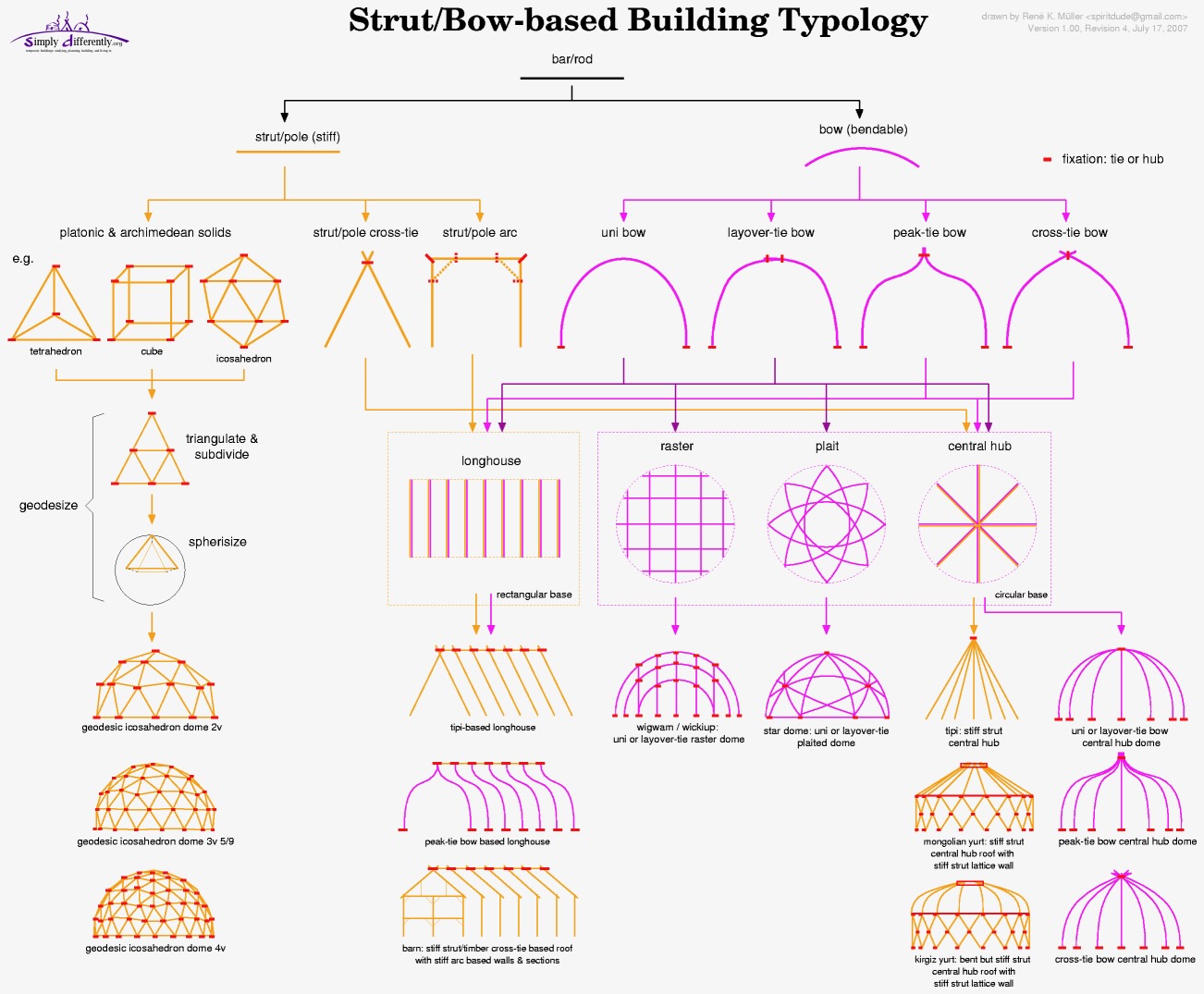
There is a diagram that has been floating around the alternative building community for almost two decades. It was drawn by Rene K. Muller of Simply Differently in 2007, and it maps every major structural typology that starts from a single premise: take a bar or rod, and build a shelter.
Diagram: "Strut/Bow-based Building Typology" by Rene K. Muller, SimplyDifferently.org, Version 1.00, Revision 4, July 17, 2007. Used with attribution.
It is one of the best single-page summaries of structural architecture ever created. And it tells you exactly where the Thiosphere sits in the history of human building.
The Two Families: Stiff vs. Bendable
Every stick-based structure begins with one choice: is your member stiff (a strut or pole) or bendable (a bow)?
Stiff struts give you platonic solids, cross-ties, and arcs. Think: lumber, steel tube, rigid pipe. The geometry is precise. The joints are fixed. The result is strong but requires exact cuts.
Bendable bows give you tension-based curves. Think: bamboo, PVC, bent wood. The geometry is organic. The shape comes from the material. The result is lightweight but harder to seal.
Most of modern construction lives entirely in the strut world. The bow world belongs to indigenous builders, festival structures, and experimental architecture.
The Strut Family Tree
On the strut side, three branches emerge:
Platonic and Archimedean solids — tetrahedrons, cubes, icosahedrons. These are the mathematical primitives. Pure geometry. Beautiful but not immediately habitable.
Strut/pole cross-ties — the basis of conventional framing. Two-by-fours nailed in rectangles. This is how 90% of houses in North America are built. Simple, well-understood, but wasteful: every corner is a thermal bridge, every wall is a flat plane that fights wind loads.
Strut/pole arcs — curved strut assemblies. Quonset huts, arch structures. Stronger than flat walls but harder to frame with standard lumber.
Where Geodesic Domes Come From
Follow the platonic solids branch down and you hit a fork: triangulate and subdivide, or geodesicize and sphericize.
Triangulating an icosahedron gives you the geodesic dome. Buckminster Fuller did not invent the geometry — he named it, patented a construction method, and spent decades proving it was the most efficient way to enclose volume with the least material.
The diagram shows the progression clearly: icosahedron to 2V geodesic dome to 3V 5/9 dome to 4V dome. Each subdivision increases the sphere approximation and the number of unique strut lengths.
This is exactly where Thiosphere lives. We build geodesic icosahedron domes — specifically a modified 2V geometry with pentagonal and hexagonal modules that bolt together.
The Bow Family Tree
The bow side of the diagram is equally rich. Four attachment methods branch out:
- Uni bow — single continuous arch
- Layover-tie bow — bows crossed and tied at intersections
- Peak-tie bow — bows meeting at the apex
- Cross-tie bow — bows crossed with rigid connections
These give you wigwams, star domes, yurts, and various dome hybrids. The Mongolian yurt — arguably the most successful portable building in human history — lives at the intersection of stiff strut lattice walls and peak-tie bow roofing.
Why This Matters for Open-Source Building
Understanding the typology matters because it shows that every building system is a set of trade-offs:
Geodesic domes maximize structural efficiency and volume-to-surface ratio, but require precise cuts and many unique angles.
Rectangular framing is simple and uses commodity lumber, but wastes material and creates weak points at every corner.
Yurts are portable and proven over millennia, but require specialized materials (lattice walls, tension bands, canvas).
Longhouses are easy to extend, but structurally redundant — every section repeats the same loads.
The Thiosphere system chose geodesic geometry specifically because it lets us:
- Maximize enclosed volume with minimal lumber
- Modularize into repeatable pentagon and hexagon units
- Flat-pack for shipping (modules nest)
- Open-source the geometry — the math is public, the cut lists are generated, the CAD models are free
The Missing Branch
What the 2007 diagram does not show is what happens when you add software to the equation.
Traditional geodesic dome builders need lookup tables, complex angle charts, and years of experience to get cuts right. The Thiosphere configurator eliminates that barrier. You design in 3D, the system generates your exact cut list with angles and lengths, and you source materials locally.
This is the branch the diagram could not have predicted: computationally-assisted modular construction. The geometry is 60 years old. The ability to let anyone configure and build it is brand new.
Try It Yourself
The Thiosphere configurator lets you design your own geodesic structure, generate a bill of materials, and get sourcing recommendations — all in your browser.
Every structure you see in that typology diagram required specialized knowledge to build. We are working to make at least one branch of that tree accessible to anyone with a miter saw and a weekend.