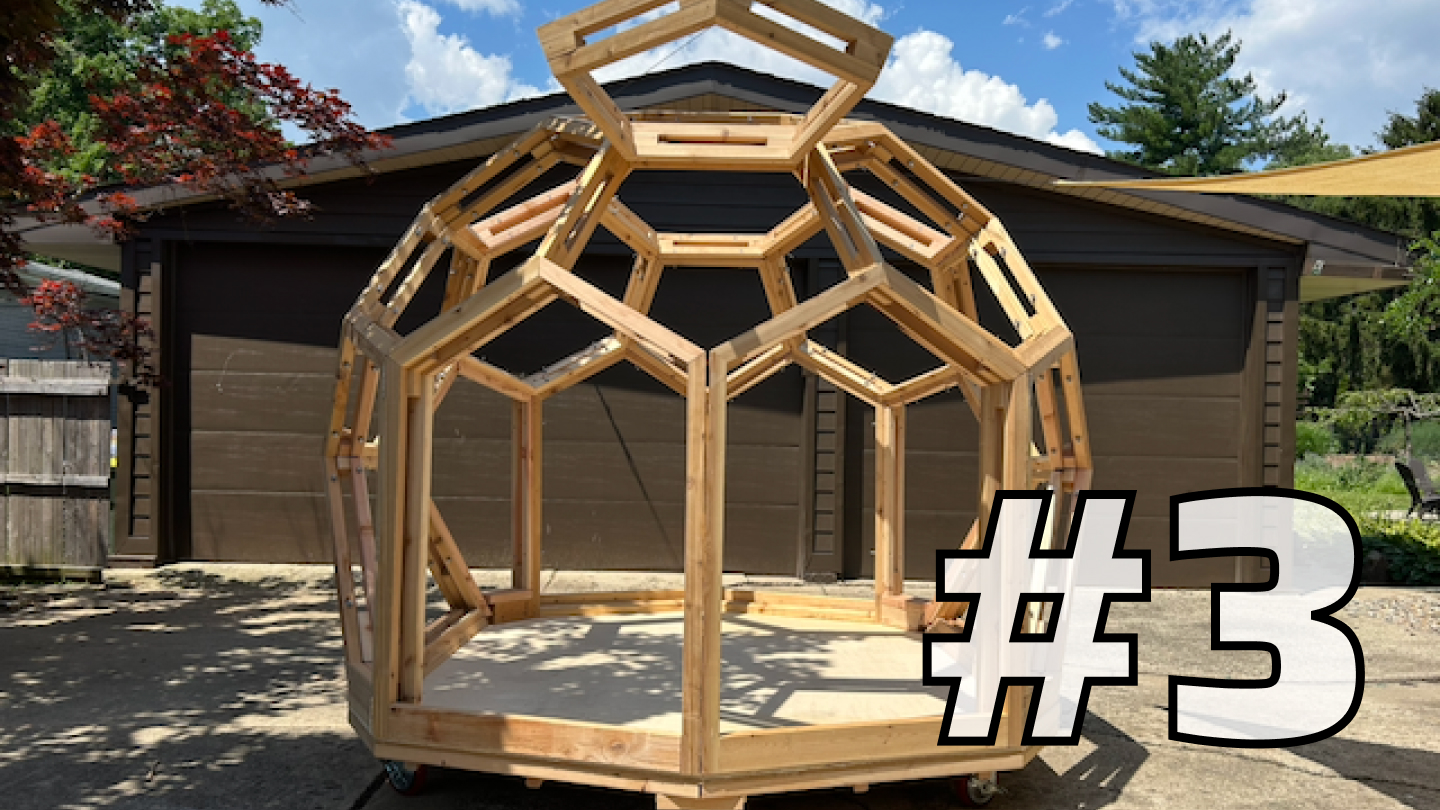
This is the one I wanted from the beginning.
The Saunosphere was a strategic choice — forgiving requirements, fast feedback. The Immosphere proved platform versatility. But the Agrosphere was always the vision: year-round food production in half a parking space.
This is what started the whole project. Sitting at my desk, eating a salad, calculating the carbon footprint of air-freighted arugula. Asking: what would it take to grow this myself, year-round, in Minnesota?
Proto 3 is the answer.
The Challenge
Growing food indoors is hard. Plants have requirements that don't care about your schedule or preferences:
Light: Plants need 12-16 hours of bright light daily. Not just any light — specific wavelengths for photosynthesis. The sun provides this free; artificial alternatives are expensive.
Temperature: Most food crops want 65-80°F (18-27°C). Too cold and they stop growing; too hot and they stress. Maintaining this in a small structure, in variable weather, is a control problem.
Humidity: 50-70% relative humidity for most crops. Too dry and leaves wilt; too wet and fungal diseases flourish. The swing between these extremes can happen in hours.
Airflow: Plants need CO2 near their leaves for photosynthesis, but they also need air movement to prevent stagnant, humid pockets where disease thrives.
Water and nutrients: Continuous supply, properly balanced. Too much and roots drown; too little and plants wilt. pH and nutrient concentrations matter.
The Saunosphere needed to get hot. The Immosphere needed good acoustics. The Agrosphere needed to keep finicky organisms alive through Minnesota's -20°F winters and 95°F summers.
This is a harder problem.
Design Adaptations
The basic Thiosphere structure remained, but the Agrosphere required significant adaptations:
Glazing
A sauna has no windows — you want to retain heat. An entertainment pod has minimal windows — you want to control light.
A growing space needs maximum light transmission. The entire south-facing portion of the Agrosphere is glazed with twin-wall polycarbonate panels. This provides:
- 80%+ light transmission
- R-1.5 insulation (not great, but better than single glass)
- Impact resistance
- Diffused light (reduces hot spots, benefits plants)
The north-facing portion remains opaque and insulated. This reduces heat loss at night while maximizing solar gain during the day.
Climate Control
The mini-split that cooled the Immosphere wasn't sufficient for the Agrosphere's demands. Growing spaces can swing 40°F in a day as clouds come and go.
The Agrosphere uses:
- Mini-split heat pump: Primary heating and cooling
- Radiant floor heating: Low-temperature backup for cold nights
- Powered ventilation: Air exchange and humidity control
- Shade cloth: Deployable covering for extreme sun
- Thermal mass: Water containers that absorb excess heat and release it at night
This is the most complex HVAC of any Thiosphere variant. It's also the most critical — a few hours outside the right temperature range can damage weeks of growth.
Irrigation
The Agrosphere uses a hybrid growing system:
Raised beds along the perimeter for soil-based crops — tomatoes, peppers, herbs that prefer traditional growing media.
Vertical hydroponic towers in the center for leafy greens — lettuce, spinach, chard, kale. These produce high volume in small footprint.
Both systems connect to a central reservoir with automated dosing. pH and EC (electrical conductivity, a proxy for nutrient concentration) sensors trigger adjustments. A small pump circulates nutrient solution.
This is more complex than backyard gardening but less complex than commercial hydroponic operations. The goal was "set and monitor" rather than constant manual adjustment.
Lighting
Even with maximum glazing, Minnesota winter days are short — 8-9 hours of weak, low-angle sun. Plants need more.
Supplemental LED grow lights fill the gap:
- Red and blue spectrum for photosynthesis
- Timer-controlled to extend "daylight" to 14-16 hours
- Dimmable to respond to natural light conditions
In summer, the lights barely run. In winter, they're essential. The energy cost is real but manageable — roughly $30-50/month in the darkest months.
The Build
The structural build followed the established pattern — faster than Proto 1, slightly slower than Proto 2 due to the glazing complexity.
| Phase | Days |
|-------|------|
| Platform | 1 |
| Outer shell (modified for glazing) | 1.5 |
| Inner shell and insulation | 1 |
| Glazing installation | 1 |
| Climate systems | 1 |
| Growing systems | 1.5 |
| Total | 7 days |
The growing systems (beds, towers, irrigation) took longer than expected. Plumbing is fiddly work.
Cost:
| Category | Cost |
|----------|------|
| Structure (modified) | $2,600 |
| Polycarbonate glazing | $480 |
| Climate control systems | $1,400 |
| Growing systems | $650 |
| Irrigation and plumbing | $320 |
| Grow lights | $380 |
| Sensors and automation | $250 |
| Total | $6,080 |
This is the most expensive Thiosphere variant, primarily due to climate control and growing infrastructure. The ongoing costs (electricity, nutrients, seeds) add roughly $30-50/month.
First Growing Season
Proto 3 was completed in early spring 2025. The first growing season provided real data:
What Grew
Excellent results:
- Lettuce (multiple varieties): Fast, productive, consistent
- Spinach: Thrived in the cooler shoulder seasons
- Kale and chard: Continuous harvest for months
- Basil: Loved the warmth and light
- Cherry tomatoes: Prolific once established
Good results:
- Peppers: Slower than hoped, but productive
- Cucumbers: Needed more vertical space than planned
- Green onions: Easy, continuous harvest
Challenges:
- Root vegetables: Not suited to the growing systems used
- Large fruiting plants: Space constraints limited options
Production Numbers
From April through October (7 months), Proto 3 produced:
- Leafy greens: ~180 lbs
- Tomatoes: ~60 lbs
- Peppers: ~25 lbs
- Herbs: ~15 lbs
- Other: ~20 lbs
Total: approximately 300 lbs in the first partial season.
Projected annual production (with winter growing): 450-550 lbs.
This matches the 500+ lbs estimate I'd made theoretically. Real data confirming predictions is satisfying.
What It Replaced
Before the Agrosphere, my household bought roughly:
- $400/year in salad greens
- $200/year in tomatoes
- $150/year in herbs
- $100/year in peppers
Total: ~$850/year in produce the Agrosphere can replace.
At current production rates and ongoing costs, the Agrosphere should pay for itself in 7-8 years — then produce essentially free food indefinitely.
But the real value isn't financial. It's eating a salad that was growing an hour ago. It's knowing exactly what went into your food. It's the satisfaction of production.
Lessons Learned
Climate Control Is Everything
I underestimated how much effort would go into climate management. The first month involved daily adjustments: tweaking vents, repositioning shade cloth, adjusting thermostat setpoints.
Eventually, I dialed in the settings and the system mostly ran itself. But that initial tuning period was intensive.
The handbook now includes detailed climate management guidance: what to monitor, what to adjust, how to interpret sensor readings.
Start Simple
My first instinct was to maximize: every square inch planted, advanced hydroponic systems, complex scheduling.
This was a mistake. I overwhelmed myself with tasks and the plants overwhelmed each other with competition.
Better approach: start with half the planned capacity. Learn the space. Add more once you understand the environment.
Respect the Learning Curve
I killed plants. Lettuce bolted because I let it get too hot. Basil damped off because I overwatered seedlings. Tomatoes developed blossom end rot because I let calcium deplete.
Each failure taught something. By mid-season, the failures were rare.
New growers should expect this learning curve. The Agrosphere enables growing; it doesn't guarantee success. Skill matters.
Pests Find a Way
I thought an enclosed structure would eliminate pests. It reduced them, but didn't eliminate them.
Aphids appeared (probably came in on transplants). Spider mites found the warm, dry environment appealing. Fungus gnats bred in wet soil.
Integrated pest management — beneficial insects, sticky traps, careful hygiene — controlled these problems. But "pest-free" isn't realistic.
The Carbon Question
Does the Agrosphere actually reduce carbon footprint? Let me revisit the calculation from my earlier post:
Agrosphere annual carbon:
- Electricity (climate control, lights): ~800 kWh × 0.4 kg CO2/kWh = 320 kg
- Materials (amortized over 20 years): ~25 kg
- Nutrients and supplies: ~10 kg
- Total: ~355 kg CO2/year
Production: ~500 lbs = 227 kg of produce
Agrosphere carbon intensity: ~1.6 kg CO2 per kg produce
Comparison:
- Grocery store conventional: ~2-3 kg CO2/kg
- Grocery store organic (shipped): ~2-4 kg CO2/kg
- Local farmers market: ~1-2 kg CO2/kg
The Agrosphere is competitive with local produce and significantly better than shipped grocery store produce. In mild climates (less heating needed), the numbers improve further.
The carbon case is positive but not dramatic. The other benefits — freshness, nutrition, self-sufficiency, skill development — matter more.
What's Next
Proto 3 validated the Agrosphere concept. Year-round growing in Minnesota is possible with reasonable cost and effort.
The design is now documented in the handbook. The growing systems guidance reflects real-world experience. The climate management section includes lessons from actual Minnesota winters.
This is what I wanted from the beginning: getting the carbon out of my salad. It took three prototypes and eighteen months.
It works. Now we share it.
Explore the Agrosphere — year-round growing in half a parking space.
Get the handbook — structure plans plus complete growing systems guide.
Join the community — connect with growers sharing their experience.