Proto 1 was a sauna. It proved the basic structure worked: the nested-shell design, the flat-panel construction, the DIY-accessible build process.
Proto 2 asked a different question: can the same platform serve radically different purposes?
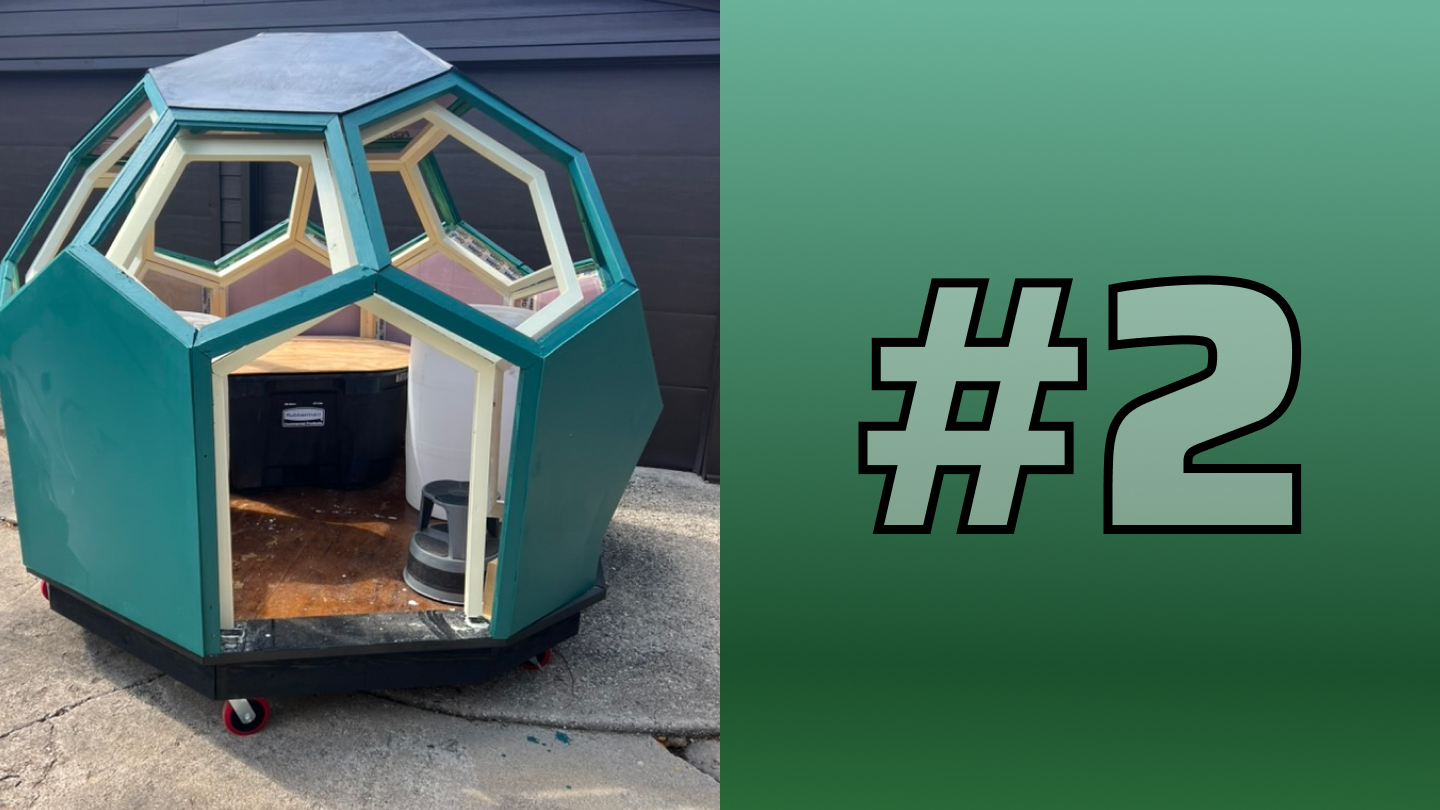
The Immosphere is an entertainment and gaming pod — a private space for immersive audio, video, and VR experiences. Physically similar to the Saunosphere, but optimized for completely different requirements.
Why Entertainment?
After Proto 1, I had a list of potential use cases to test:
- Growing space (Agrosphere)
- Home office (Ergosphere)
- Entertainment/gaming (Immosphere)
- Pool house/spa enclosure
- Meditation/yoga space
I chose entertainment for Proto 2 because it's the opposite of a sauna in almost every way:
| Sauna | Entertainment Pod |
|-------|-------------------|
| Extreme heat | Climate controlled |
| Minimal electronics | Maximum electronics |
| Wood surfaces | Acoustic treatment |
| Simple lighting | Complex A/V |
| Wet (steam, sweat) | Dry |
If the platform could serve both extremes, it could probably serve anything in between.
The Vision
The Immosphere concept: a dedicated space for immersive media experiences.
Home theater: A curved surface (the dome shape) is actually ideal for projection. No flat wall with visible edges — the image wraps around your field of view.
Gaming: Surround sound positioned for a single listener. No visual distractions. Climate controlled for long sessions.
VR: A private space where you can move without bumping into furniture or family members. Acoustic isolation so you're not disturbing others (or being disturbed).
Music listening: A room optimized for acoustics rather than aesthetics. No parallel walls to create standing waves. Acoustic treatment possible because you're not compromising with living room furniture.
The common thread: experiences that benefit from immersion and suffer from interruption.
The Build: What Changed
The structural build was nearly identical to Proto 1. Same platform, same outer shell, same basic construction sequence. This took 3 days instead of 5 — learning from the first build made a big difference.
The differences were all interior:
Acoustic Treatment
The dome shape has acoustic advantages: no parallel walls means no standing waves (the bass buildup you hear in rectangular rooms). But the curved surfaces can create flutter echoes — sound bouncing back and forth across the curve.
Solution: strategic acoustic panels on the inner shell. I used a mix of absorption panels (for mid and high frequencies) and diffusion panels (to scatter reflections rather than eliminate them).
The dome's geometry actually helped here. Because it's not a perfect sphere, the panels could be positioned at the natural flat sections rather than requiring custom curved treatments.
Electrical
A sauna needs minimal electrical: maybe a light and an outlet.
An entertainment pod needs serious power:
- Projector ceiling mount
- Surround sound (5.1 setup)
- Gaming PC location
- Multiple outlets for accessories
- Ethernet runs for low-latency connectivity
- Potential VR sensor mounts
I ran conduit during the framing phase, before closing in the walls. This made the electrical work much cleaner than retrofitting would have been.
Climate Control
The sauna actively generates heat. The entertainment pod needs to remove it — all those electronics produce thermal load.
I installed a mini-split AC unit, sized for the small space. The dome shape helped here too: the volume is smaller than a rectangular room of equivalent floor area (spheres are efficient), so the AC unit could be undersized compared to typical room calculations.
Lighting
A sauna has minimal lighting — maybe a dim fixture for ambiance.
The Immosphere has controllable lighting: RGB strips along the floor perimeter, dimmable overhead for setup/cleaning, and the projector as primary illumination during use.
All lighting is smart-home controlled, so scenes can be automated: "movie mode" dims everything and starts the projector; "game mode" activates accent lighting; "VR mode" goes to minimal light.
The Projection Surface
The interior dome surface works as a projection screen — but not directly. The inner shell material (plywood or OSB) is too textured and too absorbent.
Solution: a fabric liner stretched over the inner shell. This creates a smooth, reflective surface suitable for projection. The fabric can be removed for access to the structure underneath.
For this prototype, I used a dedicated projector screen fabric. In future versions, we may experiment with painted surfaces (special projector paint) or different fabric options.
Build Time and Cost
| Phase | Days |
|-------|------|
| Platform | 1 |
| Outer shell | 1 |
| Inner shell and insulation | 1 |
| Electrical rough-in | 0.5 |
| Acoustic treatment | 0.5 |
| A/V installation | 1 |
| Total | 5 days |
The structural build was faster (learning curve from Proto 1). The interior work was more complex. Total time was similar.
Cost:
| Category | Cost |
|----------|------|
| Structure (same as Proto 1) | $2,400 |
| Acoustic treatment | $450 |
| Electrical and lighting | $380 |
| Mini-split AC | $700 |
| Projector and mount | $1,200 |
| Audio equipment | $800 |
| Screen fabric | $200 |
| Total | $6,130 |
The A/V equipment is the variable here. You could go much cheaper (used equipment, smaller scale) or much more expensive (high-end projector, professional audio). The structure itself remained under $2,500.
What Worked
The Acoustic Environment
This was the big question: would a dome shape work for audio?
Answer: remarkably well. The combination of non-parallel surfaces and strategic absorption eliminated the boomy, muddy sound of typical small rooms. Music sounded cleaner than in my living room.
The surround sound imaging was particularly good. The curved walls helped sound blend between speakers rather than creating distinct point sources.
Projection on Curved Surface
I expected the curved projection surface to be problematic — distortion, focus issues, visible seams.
In practice, it worked better than expected. Modern projectors have enough keystone correction to handle the mild curvature. The wrap-around effect added immersion rather than distraction.
For critical viewing, the distortion is noticeable. For gaming and casual movie watching, it's a feature.
VR Space
The dome provided about 8 feet of unobstructed movement in any direction — enough for room-scale VR. No furniture to bump, no family to avoid, no need to push the couch back.
The acoustic isolation meant VR audio didn't disturb the rest of the house, and external sounds didn't break immersion.
Climate Control
The mini-split maintained comfortable temperature regardless of equipment heat load. The dome's efficient volume meant the small AC unit was more than adequate.
What Needed Improvement
Light Bleed
The door seal that was "good enough" for the sauna (some heat loss is acceptable) was problematic for the entertainment pod. Light bleed around the edges was visible when the interior was dark.
Solution: blackout gaskets and overlapping door edges. This is now specified in the Immosphere variant of the handbook.
Cable Management
I underestimated cable runs. The projector, speakers, gaming equipment, and accessories each have power and signal cables. The conduit I ran was adequate but not generous.
Solution: run more conduit than you think you need. Future plans include a dedicated cable chase.
Acoustic Panel Attachment
The first attachment method (velcro) failed within weeks. The panels weren't heavy, but the adhesive didn't hold on the interior surface.
Solution: mechanical fasteners (screws through grommets). Uglier but permanent.
The Platform Thesis
Proto 2 validated the core thesis: the Thiosphere platform can serve radically different purposes.
The structure — platform, outer shell, inner shell, insulation — is a constant. The interior configuration is the variable.
This matters because:
One learning curve: Build one Thiosphere and you understand the system. Your second build (for a different purpose) is faster because the construction approach is familiar.
Shared documentation: The handbook can cover the common structure once, then branch into use-specific variations. This is more efficient than separate plans for each product.
Adaptability: If your needs change, the structure adapts. Convert a home office to a guest room. Convert a workshop to a sauna. The bones are the same.
User Response
The Immosphere attracted a different audience than the Saunosphere:
- Gamers interested in dedicated play spaces
- Audiophiles interested in purpose-built listening rooms
- VR enthusiasts needing room-scale space
- Content creators wanting recording/streaming environments
The common thread: people whose hobbies are constrained by sharing space with family or roommates. The appeal is dedicated space for specific activities.
Several visitors asked if they could use the structure for music production. The acoustic properties that work for listening also work for recording. This wasn't an intentional design goal, but it's a natural extension.
What's Next
Two prototypes, two use cases, both successful.
Proto 3 will return to my original motivation: the Agrosphere growing space. This is the most demanding use case — precise climate control, humidity management, lighting requirements for plants.
If the platform can grow food, it can do anything.
On to Proto 3.
Explore the Immosphere — entertainment pods for immersive experiences.
Get the handbook — structure plans plus Immosphere configuration guide.
Join the community — connect with others building entertainment spaces.