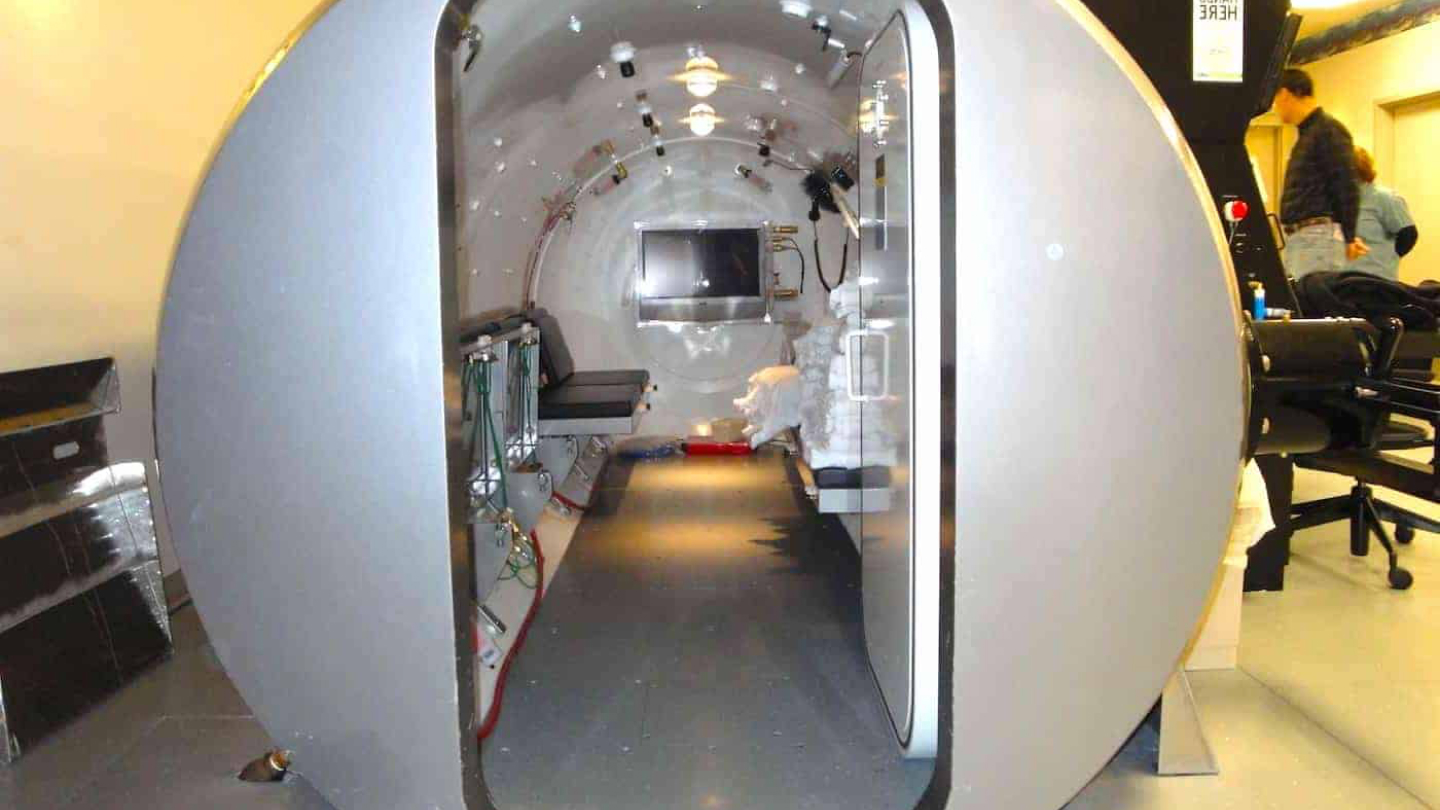
This post is not a product announcement. It is barely a concept. What it actually is: an engineering question that refuses to leave me alone, written down so it stops rattling around my skull at 2am.
The question: could the Thiosphere panel geometry — reversed — hold enough pressure to function as a personal hyperbaric oxygen therapy chamber?
The honest answer, right now, is probably not. But the geometry is interesting enough to explain why, and the reasons it fails are instructive in ways that matter for the platform.
What HBOT Is and Why It Costs a Fortune
Hyperbaric oxygen therapy means breathing pure oxygen inside a pressurized chamber. The pressure — typically 2.0 atmospheres absolute (ATA) or higher for clinical treatment — forces more oxygen into your blood plasma than your lungs can deliver at normal atmospheric pressure.
This is not fringe science. The FDA has cleared HBOT for 13 medical conditions including non-healing wounds, decompression sickness, and radiation tissue damage. The evidence base for approved indications is solid.
What has changed recently is the longevity research. Bryan Johnson completed 60 HBOT sessions and reported a 28% reduction in p-Tau217, a dementia risk biomarker. Dr. Shai Efrati at Tel Aviv University has published peer-reviewed studies showing measurable improvements in cognitive performance and telomere length.
The problem is access. Clinical sessions cost $150 to $650 each. A typical protocol runs 40 to 60 sessions. That is $6,000 to $39,000 — and insurance rarely covers off-label longevity use.
Home chambers exist, but the affordable soft-shell ones ($4,000-$7,000) only reach 1.3 ATA, below the 2.0 ATA clinical threshold. Hard-shell personal chambers that reach therapeutic pressure start at $24,000 and go to $55,000.
The therapy works. Most people cannot afford it. That gap is what keeps me thinking about this.
The Reverse Shingle: Where the Geometry Gets Interesting
Every Thiosphere is designed so that panels overlap at their edges — upper panel lapping over the lower, like roof shingles. Gravity pulls water over the overlap and away from the joint.
Now reverse it.
If the overlapping edges face inward, the same geometry that sheds water becomes a geometry that resists internal pressure. Each panel edge is held in place by the pressure pushing against it, compressing the joint tighter. The higher the internal pressure, the tighter the seal.
This is the smartest part of the idea, and I will not pretend otherwise. Using internal pressure as the sealing mechanism rather than fighting against it is elegant first-principles thinking. At 2.0 ATA — one additional atmosphere, roughly 14.7 psi — the force on each square foot of interior surface is about 2,100 pounds. That is substantial. But every overlapping edge is being pushed closed rather than pulled open.
A dome or cylinder under pressure pushes outward uniformly, trying to burst at the weakest joint. The reversed overlap turns pressure into compression at every seam.
That is the part that keeps me up at night. It is geometrically sound. Which makes the next section harder to write.
Why This Almost Certainly Cannot Be Built (As Described)
Here is where I have to be honest about the gap between geometric elegance and engineering reality. The gap is enormous.
The material problem is fatal. I am essentially describing a wooden pressure vessel filled with pure oxygen. In the world of hyperbarics, that is a high-pressure incendiary device. I mentioned "extensive fire-resistant treatment" in an earlier version of this post, and someone correctly pointed out that was a massive understatement. At 2.0 ATA with elevated O2 concentrations, materials that are barely flammable at normal pressure become aggressively combustible. Meeting NFPA 99 fire safety standards in a wood-composite structure would likely require replacing the entire interior with medical-grade alloys or specialized acrylics — which obliterates the cost advantage of modular wood panels. You cannot build a low-cost chamber if the interior has to be clad in the same materials that make existing chambers expensive.
The regulatory pathway is a graveyard. I listed FDA clearance and ASME PVHO-1 certification as things that "would need to be true." That framing was dishonest by omission. These are not milestones on a roadmap. They are multi-year, six-to-seven-figure processes that have buried companies with hundreds of millions in funding. Suggesting a modular, open-source kit could navigate medical device approval while remaining "affordable" ignores the reality of how medical device regulation works. The pathway exists to protect human life. It is expensive because the consequences of failure are fatal. This is not a process you can disrupt with clever geometry.
The safety engineering is an entire industry. Oxygen delivery at pressure requires life-support-grade equipment: medical-grade concentrators, masks, flow regulators, CO2 scrubbing, continuous atmospheric monitoring, emergency depressurization, and redundant relief systems. If a panel fails at 2.0 ATA, rapid decompression causes barotrauma — injury to ears, sinuses, or lungs. Every one of these systems needs to be designed, tested, certified, and integrated. This is not plumbing. It is aerospace-adjacent engineering.
The medical establishment does not endorse this. The UHMS — the medical society governing hyperbaric medicine — does not endorse in-home HBOT at any pressure. Their position is that this therapy belongs in accredited facilities with trained operators. I take that seriously.
So Why Write About It?
Because the geometry is genuinely novel, and writing off an idea just because the first application is impractical is how you miss the second application.
The reversed overlap — internal pressure creating self-reinforcing seals — is a real structural property of the Thiosphere panel system. It is not useful for HBOT as described (wood panels, DIY assembly, open-source kit). But it might be useful for:
Controlled atmosphere storage. Agricultural applications where modest positive pressure with inert gas (not oxygen) preserves produce. Lower pressure differential, no fire risk, no human occupancy, no medical device regulation.
Positive-pressure clean rooms. Workshops or labs that need slightly elevated internal pressure to keep contaminants out. The seal behavior works the same way at 0.1 psi as at 14.7 psi — just with far lower structural demands.
Soundproofing. A pressure-tight shell is also an air-tight shell, and air-tight shells with double-wall construction are exceptional at blocking sound transmission. The Immosphere already exploits this.
The Saunosphere. A sauna is not a pressure vessel, but the reversed overlap is relevant for steam containment. Steam wants out. Overlapping joints that compress under positive internal pressure keep it in. The temperature and humidity differentials in a sauna create meaningful positive pressure, and the same geometry handles it.
The Hyposphere as a certified HBOT chamber is, to be blunt, a fantasy at the current state of the platform. The Hyposphere as a demonstration that the panel geometry has structural properties beyond weather-shedding — that is real and that is worth documenting.
What I Am Actually Going to Do
Not build a pressurized oxygen chamber in my garage. That needs to be unambiguous.
What I am going to do is model the reversed overlap joint in FEA and see what pressure it holds before failure. No oxygen. No human occupancy. Just a structural question: at what point does a reversed Thiosphere panel joint lose its seal under internal air pressure?
If the answer is well below 2.0 ATA, the idea dies cleanly. If the answer is well above 2.0 ATA with a reasonable safety margin, then the structural property is validated — and the list of non-medical applications above becomes engineering projects rather than speculation.
Building in public means showing the ideas that do not work out alongside the ones that do. The reversed overlap geometry is real. The Hyposphere as an HBOT product is almost certainly not viable as a modular wood kit. Both of those things can be true at the same time.
What I Am Definitely Not Saying
I am not saying you should build a pressurized chamber. Pressure vessels that fail kill people. Full stop.
I am not saying the Thiosphere is ready to contain pressure of any kind. It is not. The current design is a weather-shedding shelter, not a pressure boundary.
I am not saying HBOT is safe to do at home. The medical establishment says it is not, and they know more about this than I do.
I am saying that the panel geometry has an interesting structural property that deserves investigation, and that the cost of HBOT is a problem worth caring about even if this particular approach turns out to be a dead end.
The rest is engineering. And sometimes engineering starts with an idea that is 90% wrong and 10% worth pursuing.
This post is speculative. The Hyposphere does not exist as a product and is not available for purchase or pre-order. Do not attempt to pressurize any Thiosphere structure. HBOT should only be conducted in certified chambers under appropriate medical guidance.
Explore the Thiosphere Platform — the base module system
Read How the Panels Work — the geometry behind the idea
Join the Discussion — engineers, doctors, and curious people welcome