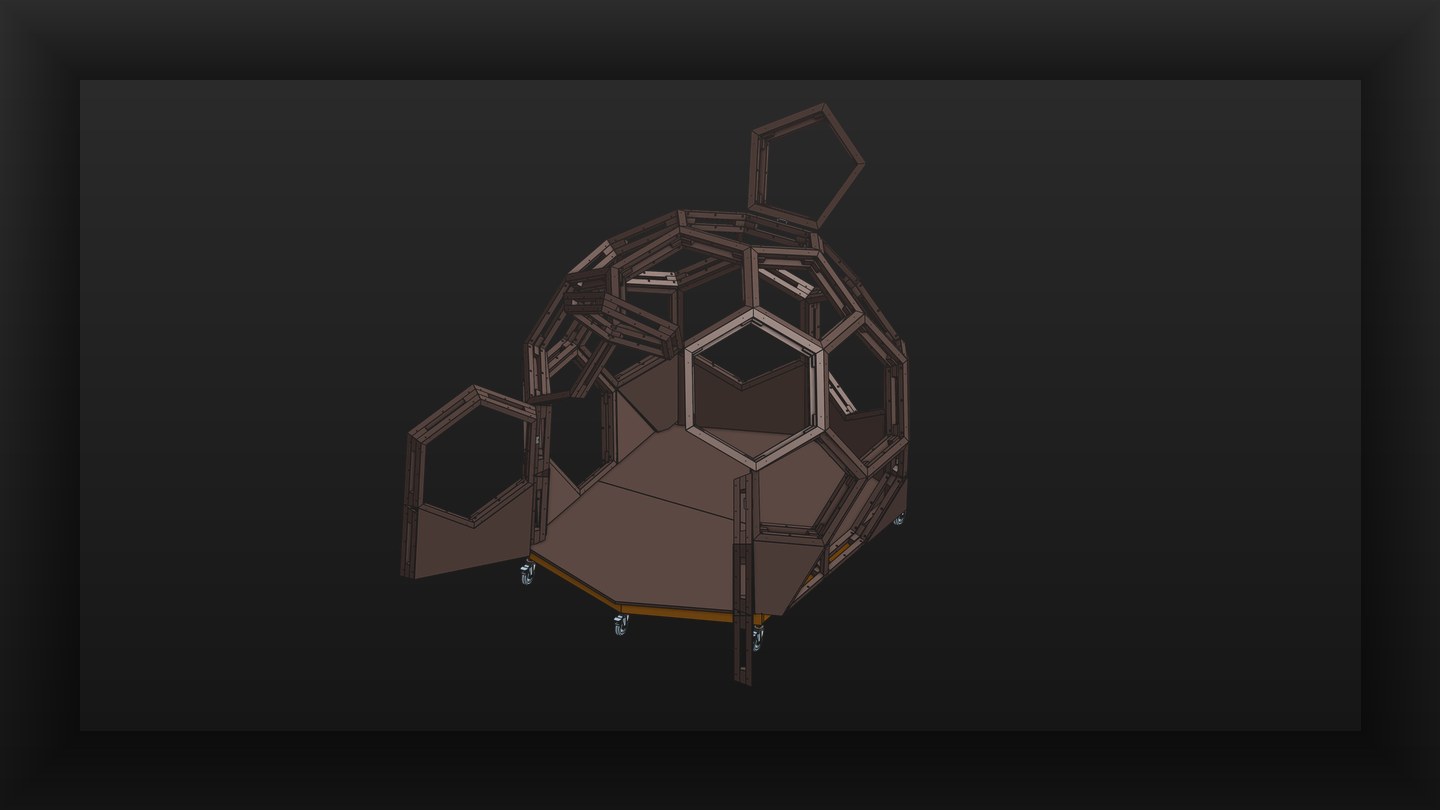
I have written about how the double-shell truncated icosahedron serves heat, light, focus, and immersion. Each of those posts describes a specific product — Saunosphere, Agrosphere, Ergosphere, Immosphere — optimized for a specific function.
This post is about the thing underneath all of them: the Thiosphere itself. The base platform. The twenty-two module types that do not care what you put inside them.
Because the most important product in the lineup is the one with no predetermined function.
The USB Port of Shelter
In 1996, USB replaced a mess of incompatible connectors — serial ports, parallel ports, PS/2, proprietary charging cables — with a single standard interface. The connector did not know whether it was carrying data, power, audio, or video. It provided a standardized physical and electrical interface. What passed through it was up to the devices on each end.
The Thiosphere is a USB port for shelter.
Twenty-two module types. Standard dimensions. Standard connections. Standard materials. What goes inside — the function, the finish, the equipment, the purpose — is up to you. The platform does not know whether it is a sauna, a greenhouse, an office, or a chicken coop. It provides structure, weather protection, thermal performance, and modularity. The application layer is yours.
This matters because shelter needs are not standard. A retiree in Portugal needs a different space than a game developer in Toronto than a market gardener in Wisconsin than a musician in Berlin. Designing a separate product for each of these people is impossible. Designing a platform that each of them can configure is not.
What Twenty-Two Modules Actually Means
The Thiosphere module set is small enough to memorize and large enough to build anything:
Structural modules form the shell geometry — the hexagonal and pentagonal frames that create the truncated icosahedron shape. These are the same for every Thiosphere variant. They never change.
Panel modules fill the structural frames. This is where differentiation happens:
- Solid insulated panels (R-20 mineral wool)
- Single-glazed window panels
- Double-glazed thermal panels
- Polycarbonate translucent panels
- Blackout acoustic panels
- Chimney panels (fire-rated thimble)
- Ventilation panels (adjustable louvers)
- Door panels (standard-width, weathersealed)
Foundation modules support the structure:
- Plinth system (adjustable posts for uneven ground)
- Trailer frame (towable, mobile)
- Caster base (lockable, repositionable)
Every module of a given type is identical. Not similar — identical. Cut from the same template, using the same materials, with the same fastener pattern. A solid panel from a Saunosphere fits a Thiosphere fits an Agrosphere. A door panel is a door panel regardless of what is on either side of it.
This is the core constraint that the truncated icosahedron enables. Because the panels are flat, every panel of a given type is geometrically identical. A geodesic dome cannot make this claim — its panels are position-dependent. A rectangular building can make this claim for walls but not for the roof or the floor connection. The Thiosphere makes it for every module in the set.
Configuration as Design
When modules are standardized and interchangeable, design becomes configuration rather than engineering.
You do not design a Saunosphere from scratch. You take the Thiosphere module set and choose: insulated panels here, ventilation panel there, chimney panel on the upper hemisphere, door panel facing south, trailer foundation. The sauna emerges from the configuration, not from a new design.
You do not design an Agrosphere from scratch. You take the same module set and choose: polycarbonate panels on the south face, insulated panels on the north, ventilation panels at the peak and base, door panel facing the garden, plinth foundation. The greenhouse emerges.
The configurator on our site does exactly this. You place modules in 3D space, choose panel types for each position, select a foundation, and generate a bill of materials. The BOM is specific to your configuration — the exact lumber, sheet goods, hardware, glazing, and insulation you need, with quantities and cut lists.
This is the difference between a product and a platform. A product is a fixed design that you buy or do not. A platform is a design space that you explore until you find the configuration that fits your life.
Docking: Why Flat Panels Matter Most
The Saunosphere, Agrosphere, Ergosphere, and Immosphere each demonstrate what the platform does in isolation — one module, one function. But the Thiosphere system is designed for connection.
Two modules dock through their door panels. The door panels align, the frames bolt together, and the interior spaces merge. The structural frames remain independent — each module carries its own loads. The connection is weathersealed at the panel edges using the same overlapping joint system that seals every other panel connection.
This is simple because the door panels are flat. Two flat surfaces meeting face-to-face create a reliable, repeatable seal. Try docking two domes and you are cutting curved openings in curved surfaces, building custom transition structures, and sealing compound curves — a bespoke engineering problem every time.
Flat panel docking means you can connect:
- A Saunosphere to an Ergosphere (sauna break during the workday)
- An Agrosphere to a Saunosphere (wood-fired heat for the greenhouse, described here)
- Two Ergospheres (a private office and a meeting room)
- Three Immospheres (a multi-room gaming arena)
- Any combination of any modules for any purpose
The configurations scale from a single module on a trailer to a campus of connected modules around a courtyard. The duo and multi-sphere posts explore these configurations in detail. The platform accommodates all of them because the docking interface is standardized.
Open Standard, Not Open Product
The Thiosphere is released under the CERN Open Hardware License v2. This means anyone can:
- Study the designs in full detail
- Modify any aspect of the geometry, panels, or connections
- Build Thiospheres for personal use
- Manufacture and sell Thiospheres commercially
- Improve the designs and share those improvements
This is not "open source" in the marketing sense where a company publishes some documentation and calls it open. The CAD files are public. The cut lists are public. The engineering calculations are public. A competent builder can manufacture every component from the published specifications without buying anything from us.
Why give this away? Because the value of a standard increases with adoption. Every builder who uses Thiosphere modules expands the ecosystem. Every manufacturer who produces panels increases availability and competition. Every improvement shared back makes the platform better for everyone.
We sell handbooks, templates, and verified build services — not the right to build. The designs are free. The documentation that makes building straightforward is what costs $29.
The Functions We Have Not Imagined
The four named products — Saunosphere, Agrosphere, Ergosphere, Immosphere — are the obvious applications. They are the ones we thought of first, designed for, and documented.
But the platform does not limit you to our imagination.
People have already suggested: artist studios, meditation spaces, small-batch commercial kitchens, photography darkrooms, ham radio shacks, beekeeping shelters, roadside farm stands, mobile veterinary clinics, disaster relief shelter, off-grid cabins, floating structures on pontoon foundations, tree-mounted structures on platform brackets.
Some of these are straightforward reconfigurations of existing module types. Some would require new panel variants — a panel with integrated power inlet, a panel with a pass-through window for commercial food service, a panel rated for marine environments. The platform accommodates new panel types without any change to the structural geometry. The frames do not care what fills them.
This is the real promise of the Thiosphere. Not any single product, but a building system flexible enough that people will invent applications we never considered. The best uses of the platform will come from builders solving problems we do not yet know about, in places we have never been, for purposes we could not have anticipated.
Our job is to make the platform robust, documented, and accessible. The community does the rest.
Building the First One
If you have read the geometry posts for each product and thought "this is interesting but which one do I actually build?" — the answer is the Thiosphere.
Build the base platform. Choose the simplest panel configuration — solid insulated panels, one door, plinth foundation. Build it in your yard over three weekends. Learn the system. Understand how the panels connect, how the double shell works, how the foundation levels.
Then decide what it becomes. Swap panels to make it a greenhouse. Add a chimney panel and a stove to make it a sauna. Put a desk in it and it is an office. The first build teaches you the platform. Every subsequent build — and every reconfiguration — is faster because the system is the same.
The modules are flat-packable. If you build a Thiosphere, decide you want a Saunosphere instead, and need different panels, you remove the panels you do not need, stack them flat, and install the new ones. The structural frame stays. The foundation stays. Only the panels change.
This is what a platform gives you that a product never can: the freedom to change your mind without starting over.
Configure a Thiosphere — start with the platform and explore configurations
Read the Full Specs — module types, dimensions, and the open-source license
The Shape of Shelter — the geometry behind the platform
Get the Handbook — complete build documentation
Join the Community — builders, makers, and inventors welcome